

Share of Voice Update

Peter Emil Tybirk
July 2, 2026
We are changing how our Share of Voice metrics work. Read more about what we are changing and what you have to do.
Share of Voice is one of the core ways to measure how visible your domain is in search. We are changing how it works, and the short version is that you will soon get to decide how it is calculated instead of picking between two separate metrics.
Here is what is changing, why, and how to set it up before the switch.
A Quick Refresher
Today AccuRanker gives you two separate versions of Share of Voice:
Share of Voice uses a static CTR, a fixed click-through rate for each rank. Rank 1 is treated as roughly 31.2% of clicks, rank 2 as about 16%, and so on down the page. Every keyword at a given rank gets the same assumed CTR.
AI Share of Voice uses a dynamic CTR instead. This is AccuRanker's machine learning estimate, and it accounts for the things that actually move click-through rates in the real world: the SERP layout, ads, search intent, and other features of the results page.
Both are then derived as the CTR * Search Volume where the Search Volume comes from Google Keyword Planner and can be either local or national depending on your settings and whether your tracked keywords have a non-national location.
What Is Changing
We are merging those two versions into a single, configurable Share of Voice. Rather than choosing between two metrics, you choose how the one metric is calculated, using two settings:
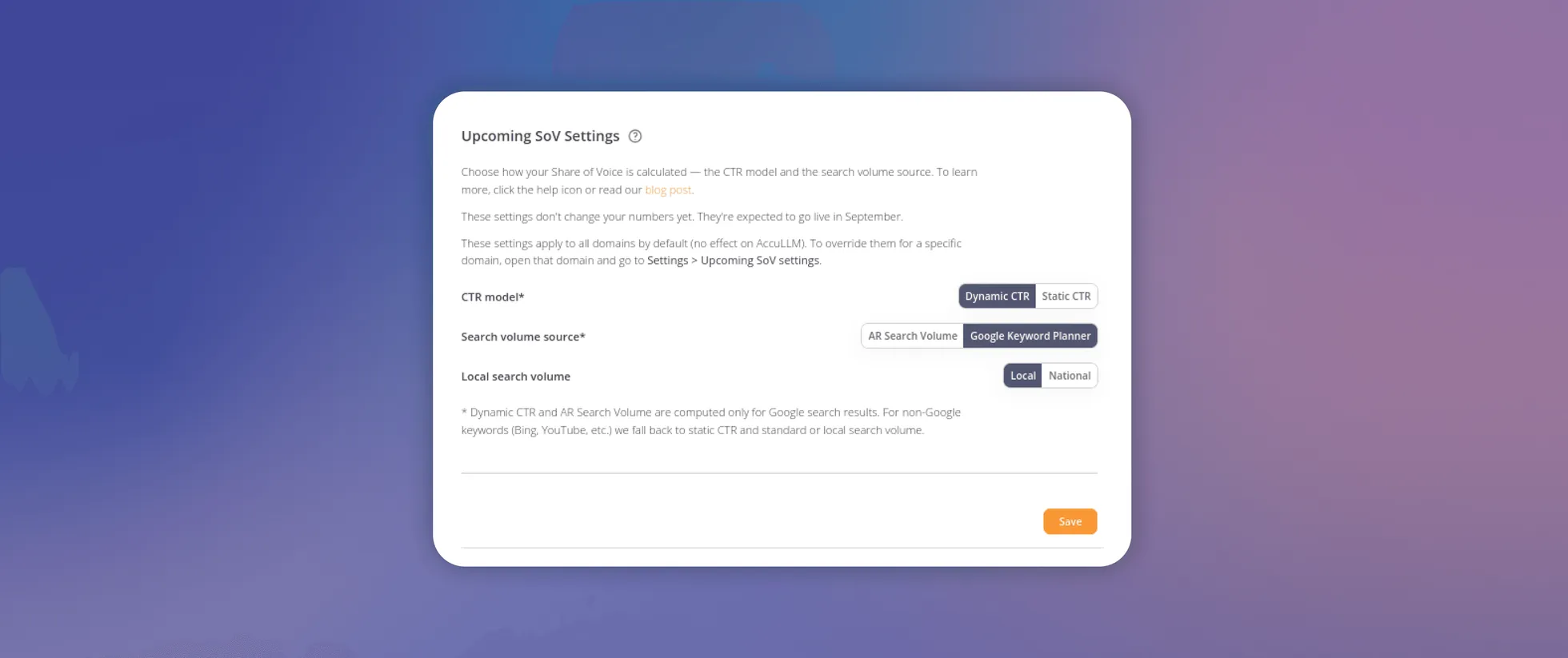
CTR model. Either dynamic CTR, which is AccuRanker's ML model, or static CTR, the fixed per-rank model.
Search volume source. Either AR Search Volume, which is AccuRanker's own estimate (this was previously called "AI Search Volume"), or Google Keyword Planner search volume, local or non-local.
That gives you four possible combinations, and you pick the one that fits how you want to read your data.
Derived metrics follow the same settings. Traffic Value, for example, is calculated from Share of Voice, so it uses whatever CTR model and volume source you have chosen. The API keeps serving all the existing metric fields, but every Share of Voice field now returns the same settings-derived value rather than splitting into a static and an AI version.
A New Share of Voice % Metric
Alongside the configurable metric, we are adding a Share of Voice % metric. It replaces the old "Show share of voice as a percentage" toggle, and it is available everywhere the regular metric is: columns, charts, KPIs, reports, and the API.
The percentage is your Share of Voice divided by the maximum Share of Voice achievable for each keyword, which gives a number on a 0 to 100% scale.
A Note on Bing, Baidu, Naver, and YouTube
Dynamic CTR and AR Search Volume are available for Google keywords only.
Keywords on Bing, Baidu, Naver, and YouTube continue to use static CTR multiplied by search volume, exactly as they do today. Nothing about those calculations changes. The one addition is that the new Share of Voice % metric shows up alongside them too, so you get the full 0 to 100% scale on those engines as well.
We Are Also Refreshing the CTR and AR Search Volume Models
The CTR update is the bigger one. The new model is built on the much richer and more granular data we have been collecting over the past 18 months, which gives it a stronger foundation for accurate estimates than what came before.
Worth knowing: because the underlying models are changing, you may see AR Search Volume and CTR values shift across your keywords even if you keep your current settings. That is expected, and it reflects more accurate estimates rather than a change in your actual rankings. We will communicate in advance when this exactly will be released and what is expected to happen to the numbers in general.
What We Recommend
If you want the most accurate picture of your organic visibility, we recommend dynamic CTR combined with AR Search Volume.
Dynamic CTR accounts for how more than 120 factors, including pixel position on the page, SERP features, and ads, affect whether people actually click. Static CTR cannot see any of that. It assumes every result at a given rank earns the same share of clicks, which rarely holds once you account for how different SERPs look.
AR Search Volume combines multiple search volume sources into a single estimate, which tends to give a more realistic read on keyword demand than any one source on its own.
Can You Keep the Legacy Model?
Yes. Static CTR with Google Keyword Planner search volume stays available, and you can keep using it if that is what your reporting depends on. You can also switch the settings as often as you want — the full history will still be available as the numbers are derived dynamically.
Why move away from the legacy model? Static CTR assumes a fixed click share per rank regardless of what the results page looks like. And Google Keyword Planner has some well-known quirks: it groups similar keywords together, its numbers can fluctuate, and it does not separate volume by device. Those are the main reasons we lean toward the dynamic model.
How to Set It Up
The settings live under your account settings, in a section called Upcoming SoV Settings. There you can:
- Choose your CTR model.
- Choose your search volume source.
If certain domains need to differ from your account default, you can override them individually in each domain's own settings.
You can switch between calculations freely, both before and after the configured Share of Voice goes live. Your existing Share of Voice numbers will not change before the cutover, and once you do change a setting, it applies across your full history automatically.
Timing and the Default
The cutover is scheduled for September.
If you set your preference beforehand, that is what you will get. If you do not change anything, your account will default to our recommended calculation, dynamic CTR with AR Search Volume, which may change the Share of Voice numbers you currently see.
So it is worth taking a minute now to open the settings and pick the combination that matches how you read your dashboards, especially if your reporting relies on the current static numbers.
Related blog posts

Introducing AccuRanker’s Full SERP Report
The full SERP report shows you the entire SERP for up to 1,000 keywords across all positions, making it easy for you to start your SERP analysis.
5 May 2025
Get Buy-In with AccuRanker's SEO Forecasting
Learn how AccuRanker's new forecasting feature helps you predict the impact of your SEO efforts and make a case for your SEO projects.
1 March 2025
How AccuRanker Determines Search Intent With AI
Learn how AccuRanker determines search intent with AI and what SERP features determine search intent.
10 December 2024