

How AccuLLM Scores Brand Sentiment in AI Answers
Emil Martin Vork Heunecke
November 16, 2026
From 23 November 2026, AccuLLM scores brand sentiment in AI answers with a new, more accurate model. This post goes into detail about how the sentiment is scored, with examples.
From 23 November 2026, AccuLLM scores sentiment with a new model for all accounts. The scores are more accurate across all seven sentiment levels.
Your sentiment history will show a step on that date. In general, expect fewer negative scores, more neutral ones, and all seven levels used more consistently. If you want the new model sooner, or your earlier answers scored with it too, contact support.
Sentiment is a measure of how favourably an AI answer speaks of your brand. In this blog post, we explain how we get from a prompt to a sentiment score and what the seven levels mean. We then go through examples, from the nuances of scoring a brand mention in a single sentence to mentions whose meaning depends on the headings and structure around them.
How a Prompt Becomes a Sentiment Score
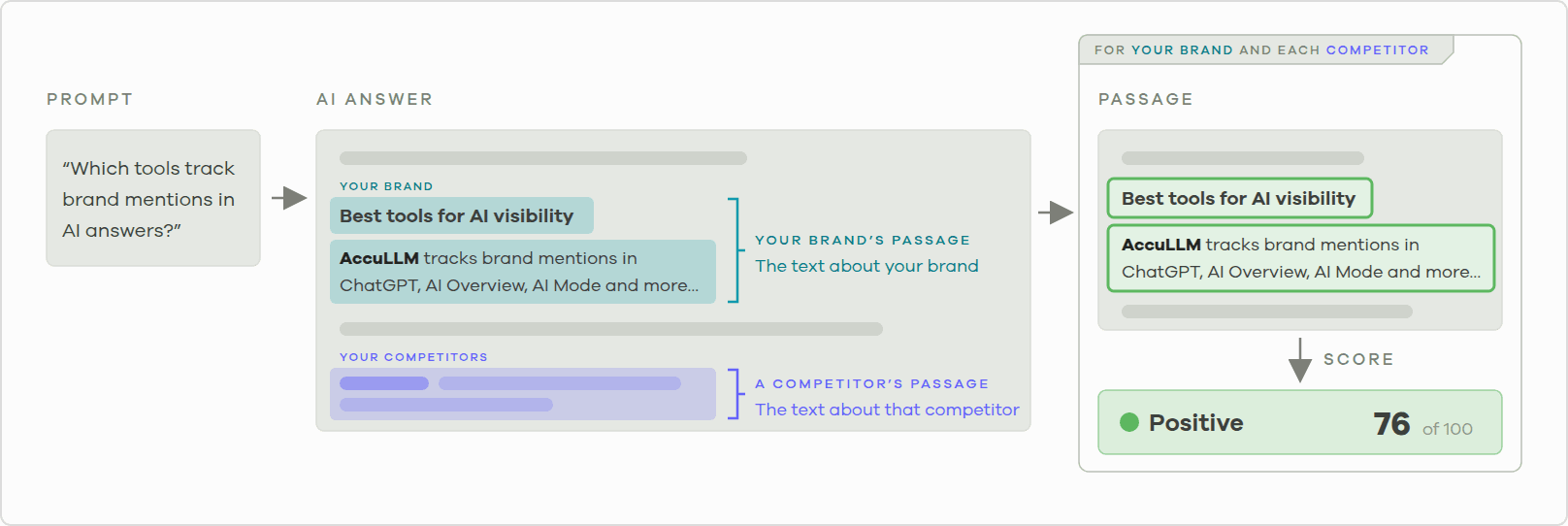
- We send each of your prompts to the AI engines you track: ChatGPT, AI Overview, AI Mode, and more.
- In each answer, we find your brand and each of your competitors by the spellings you have set up.
- Each brand we find gets its own passage: the text about that brand, along with the headings it sits under.
- We read each passage and give it a score from 1 to 100, which places it on one of seven levels.
Each brand gets one score per answer. Praise or criticism of another brand does not count toward yours, unless the answer compares the two.
The Seven Levels of Sentiment
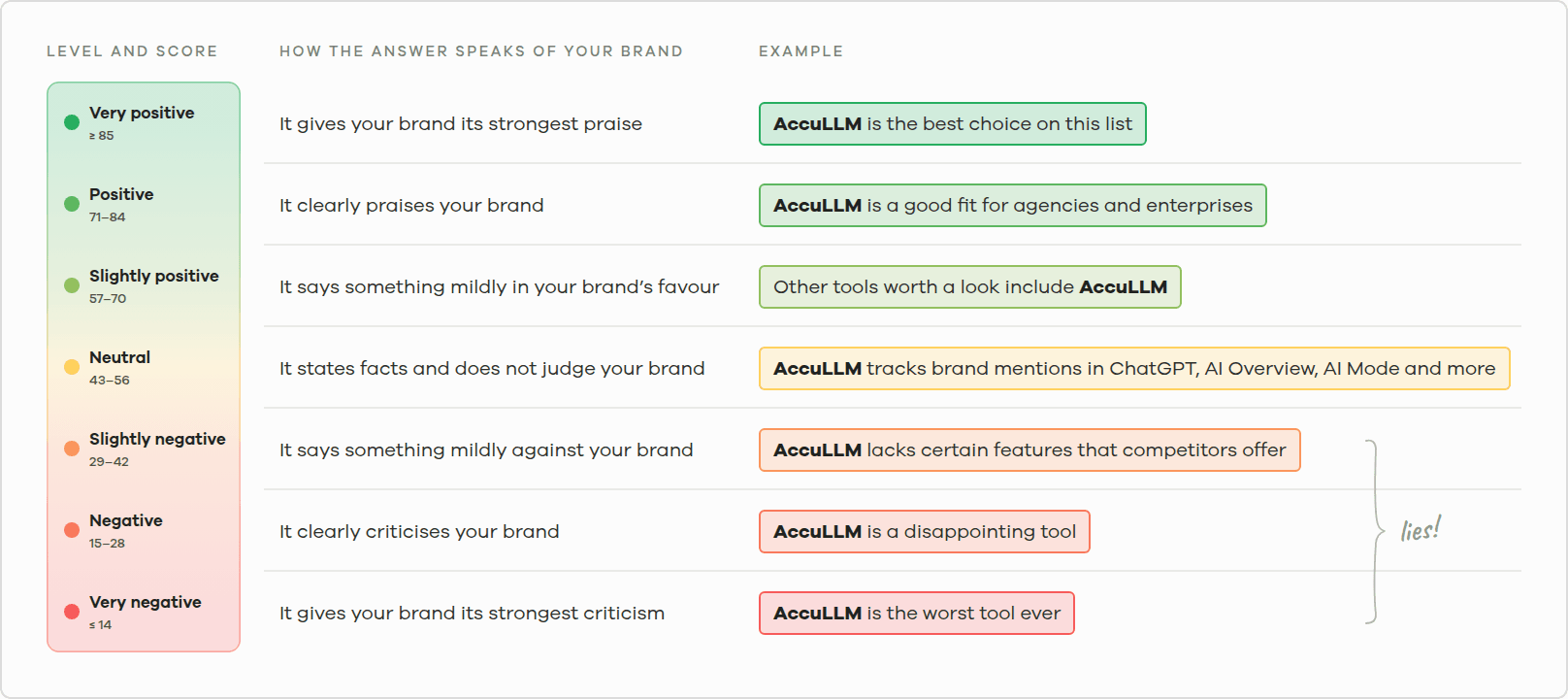
Positive, neutral, and negative alone would be too coarse. "Worth a look" and "the best choice" are both positive, but one is much stronger than the other. With seven levels, mild and strong praise get different labels, and so do mild and strong criticism.
Each level is a range on one scale, so two scores on either side of a border are still close. A 56 is neutral and a 57 is slightly positive, and the sentiment behind them is nearly the same.
Passages on Their Own
Some sentences can be judged from their own words. Even then, the wording can be tricky.
Negation
Some sentences use negative words to say something positive. Going by the words alone would get them wrong, so we score what the sentence means.

"Slow", "expensive", and "hard to use" are all criticisms. But "you won't find" negates them, and the sentence becomes praise.
Mixed sentiment
An answer often says something for a brand and something against it. When the two weigh about the same, they balance out.
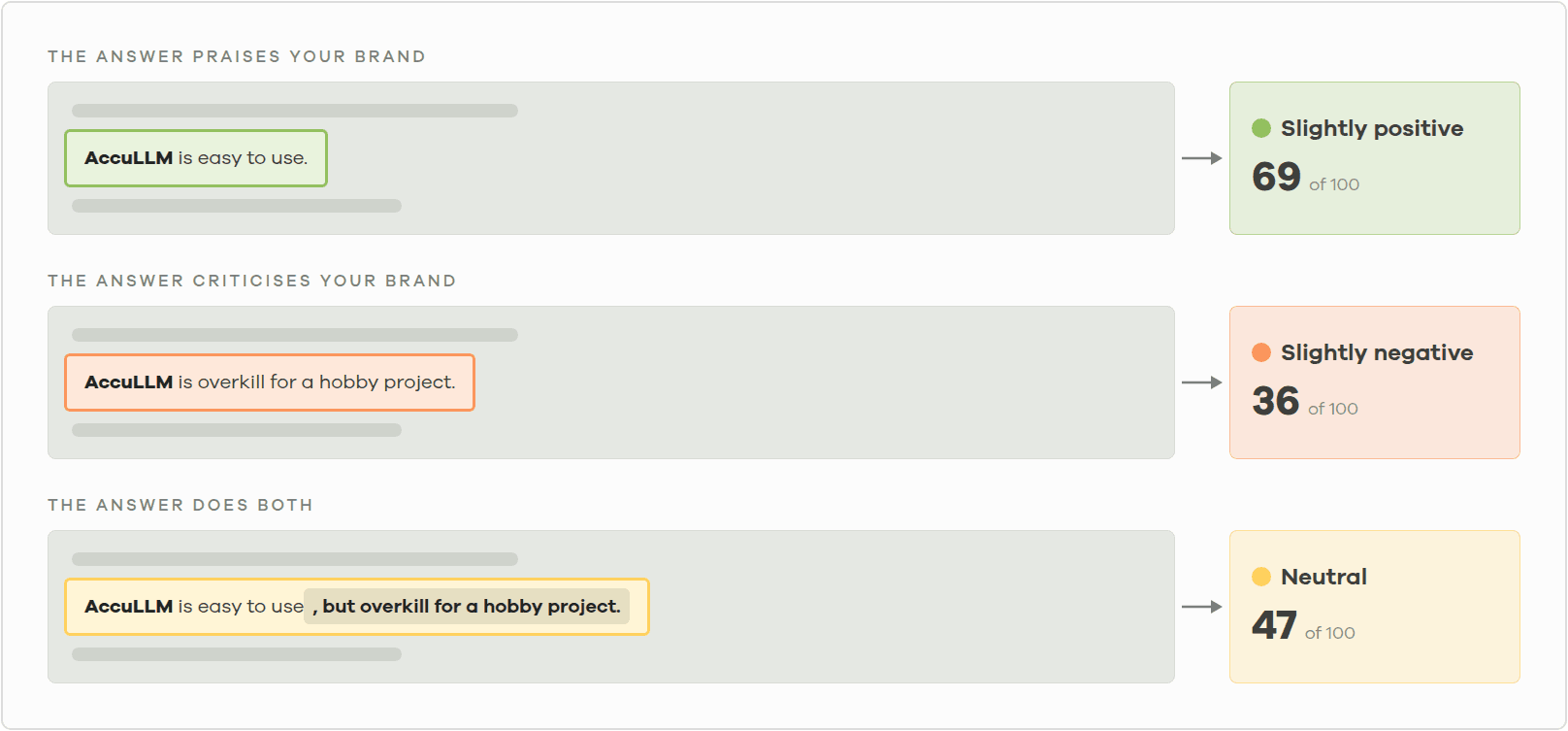
One point is for AccuLLM and one is against it. They cancel each other out, and the score lands in the middle.
Close calls
When a passage supports two readings equally well, we choose the less negative one.
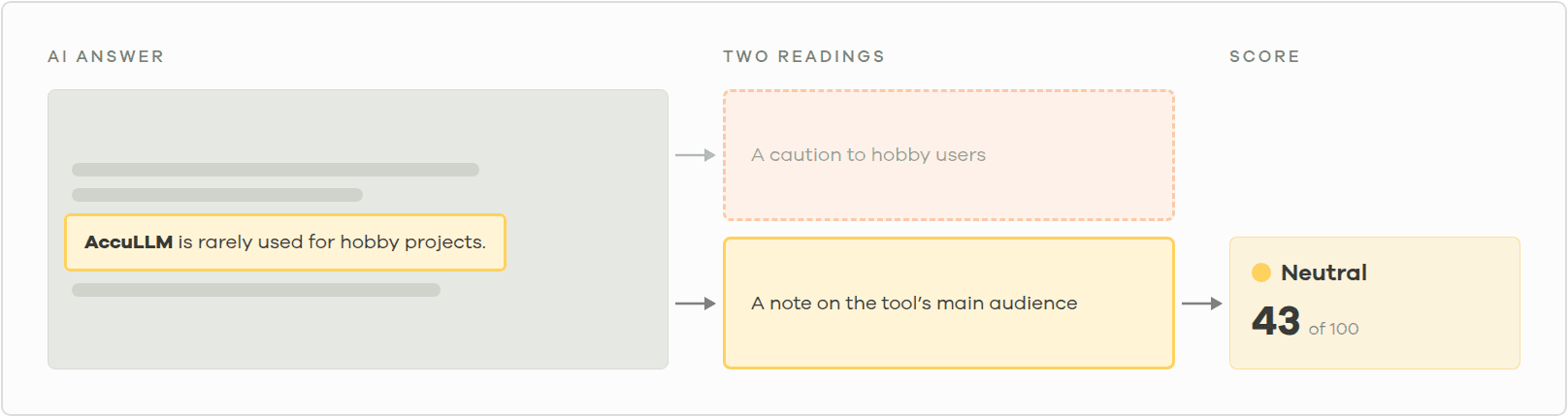
Criticism is uncommon: about 1% of brand mentions in our data read as negative. A negative score should therefore point you to something an answer really said. A wrong one costs you more than a missed mild criticism, because you would spend time looking for criticism that was never really there.
Facts and figures
AI answers often state a fact about a brand, such as a price, a feature, or a figure. A fact can sound good or bad to you, but we score only what the answer says about it.
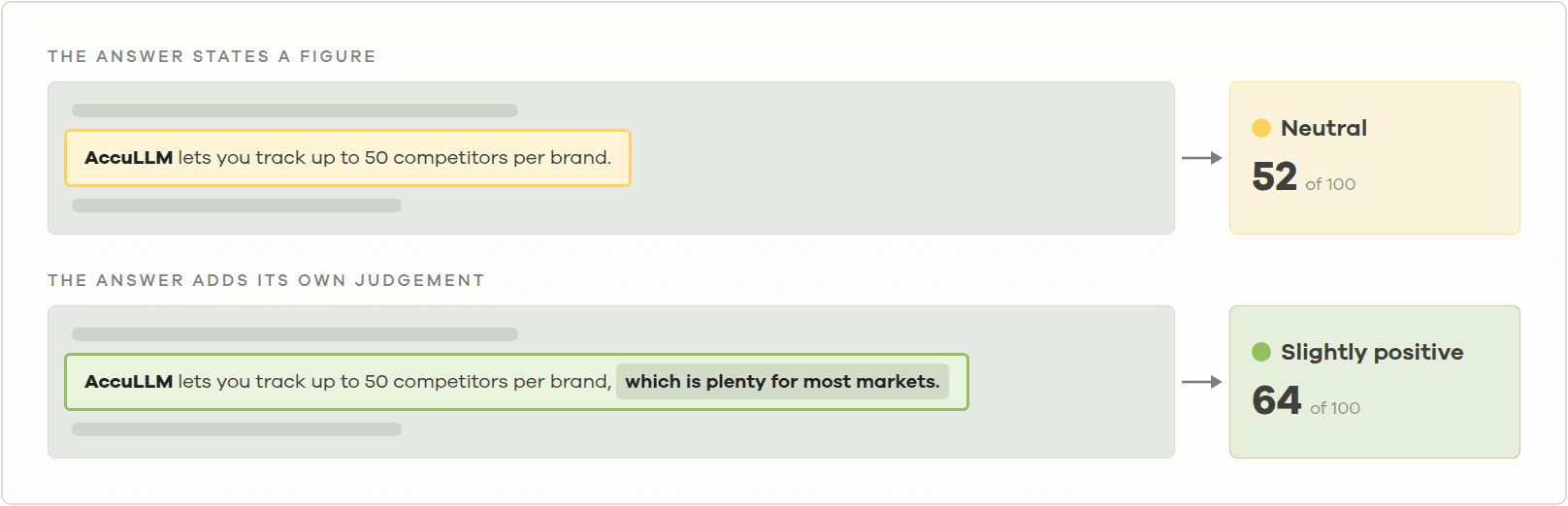
The first answer does not say whether 50 is many or few, so we score it neutral. The second calls the figure plenty, so we score it slightly positive.
Comparisons
AI answers often compare your brand with others. Being named beside other brands does not count for or against you. What counts is what the answer says about your brand in relation to the others.
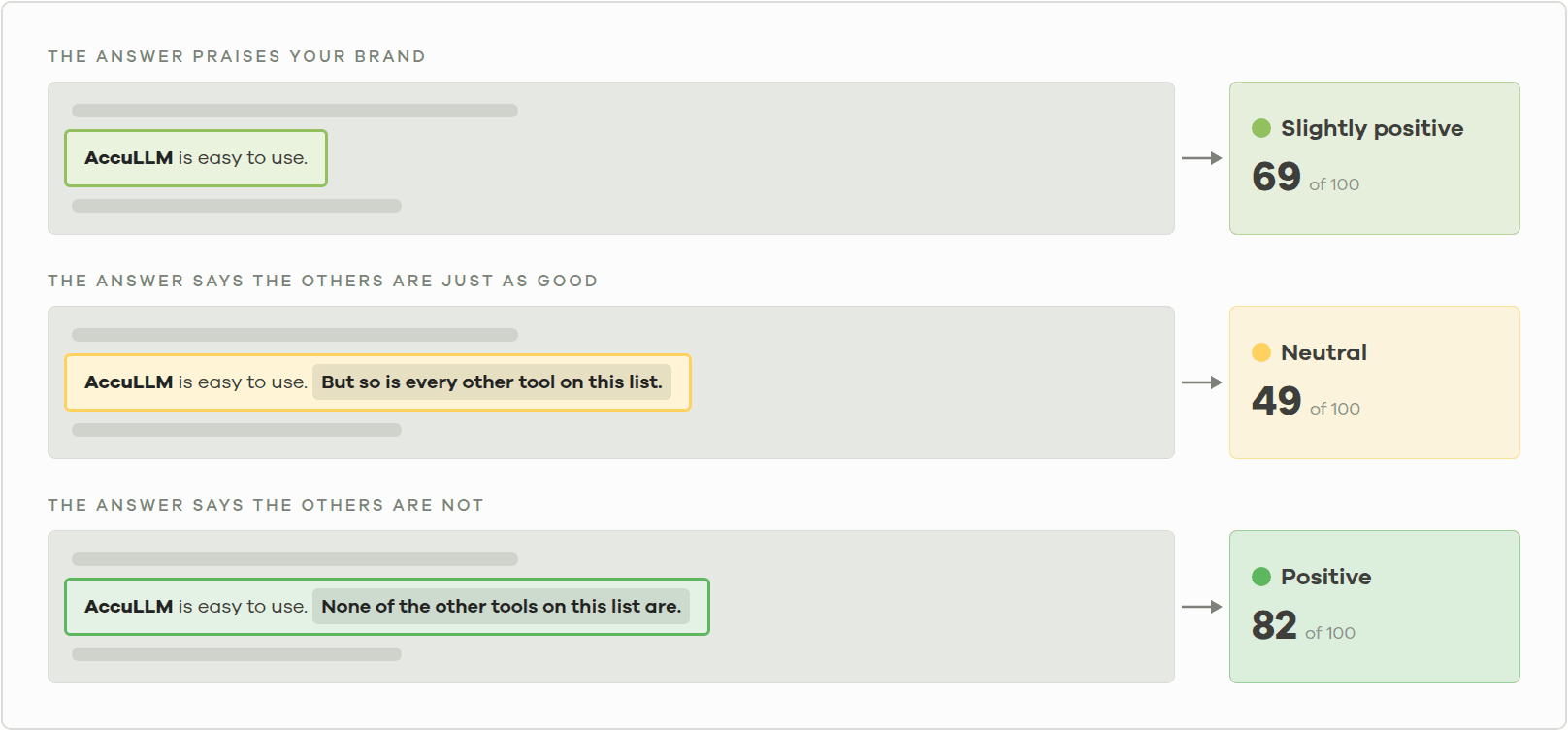
The praise is the same in all three. When every other tool shares it, it no longer sets AccuLLM apart, and the score is neutral. When no other tool does, it counts for more. The second sentence never names AccuLLM, but it belongs to the same paragraph, so we read it as part of the passage.
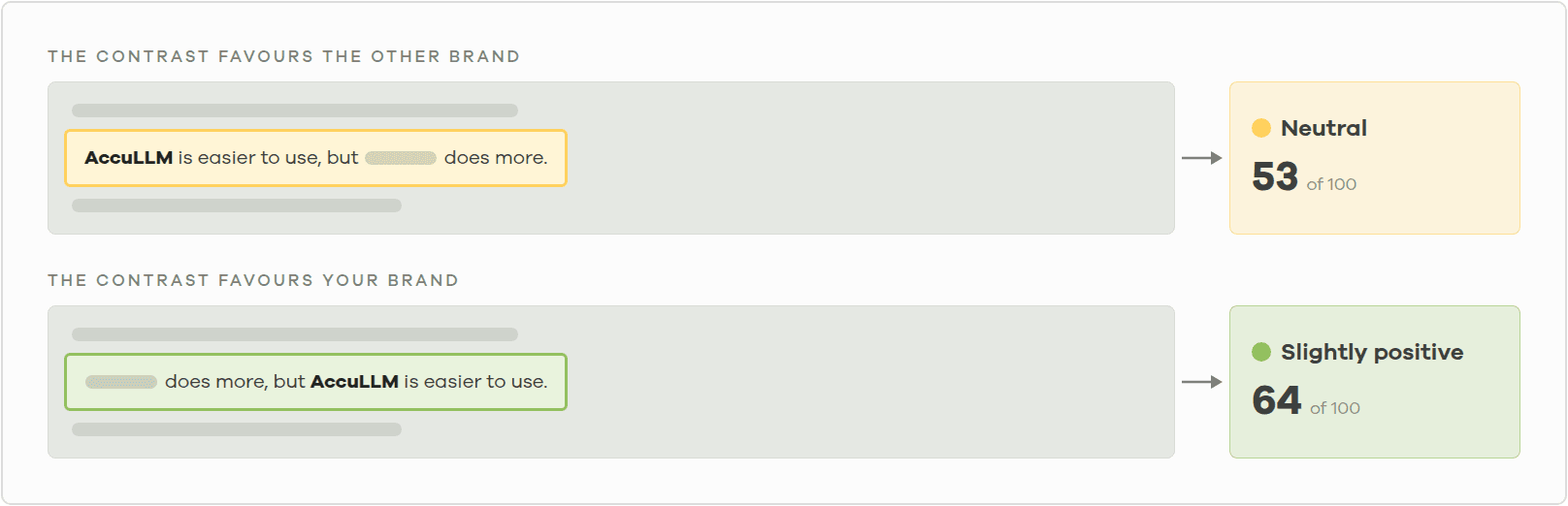
Both sentences say the same two things. The weight falls on what comes after "but", and the score follows.
Passages in Context
A passage is the text in an answer that is about your brand. We find your brand by the spellings you have set up, matched strictly, so words that only resemble it are not picked up. Around each mention we include the sentences around it that are about your brand, the points listed under it on a list, the headings above it, and, in a table, the row or column that holds the headers.
Headings and paragraphs
Often when a sentence mentions your brand, the rest of the paragraph is relevant too. So we read more than that one sentence: the rest of the paragraph that is about your brand, and the heading above it.
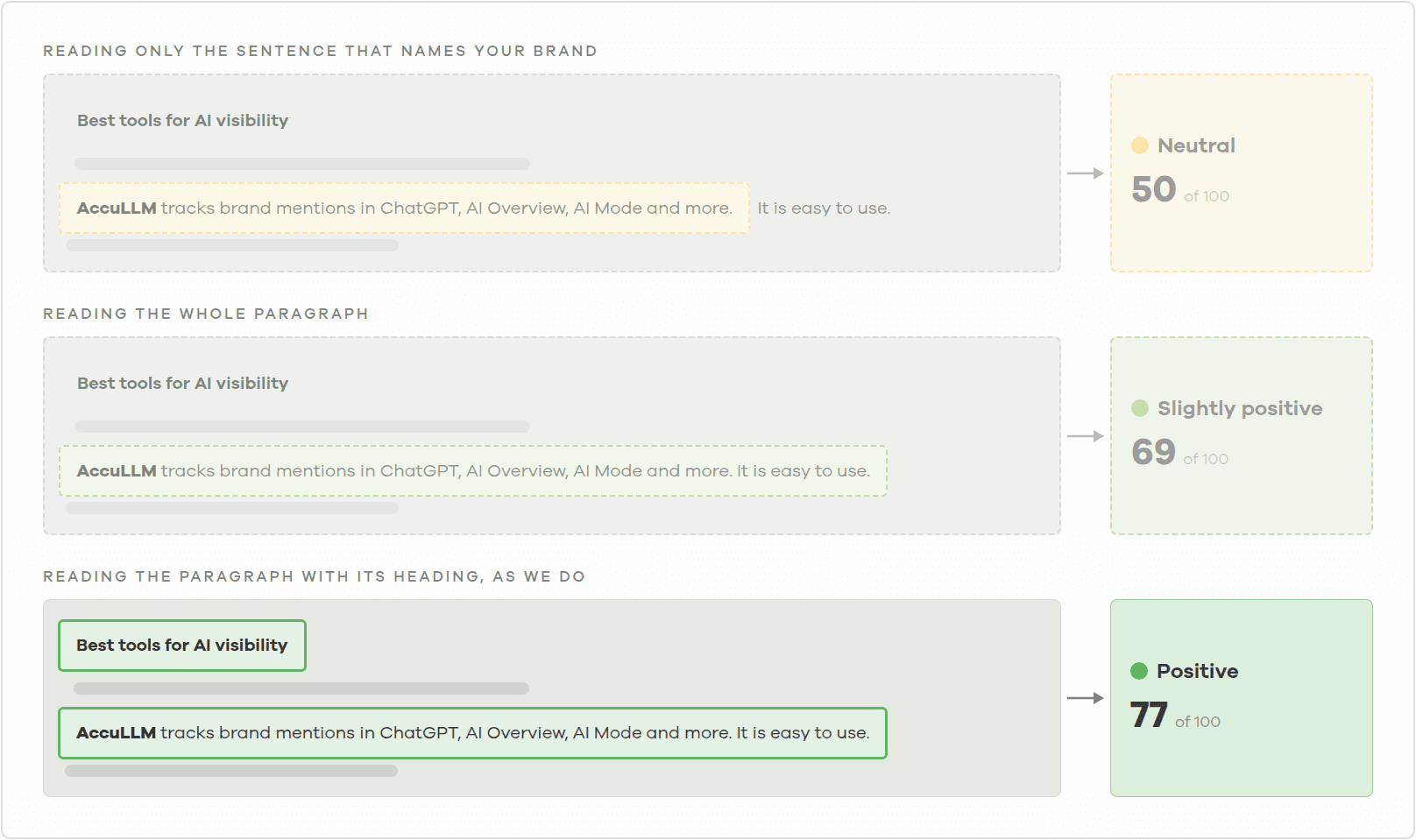
On its own, the sentence that names AccuLLM is a plain fact. The rest of the paragraph adds mild praise. The heading makes the whole paragraph a recommendation.
Lists and tables
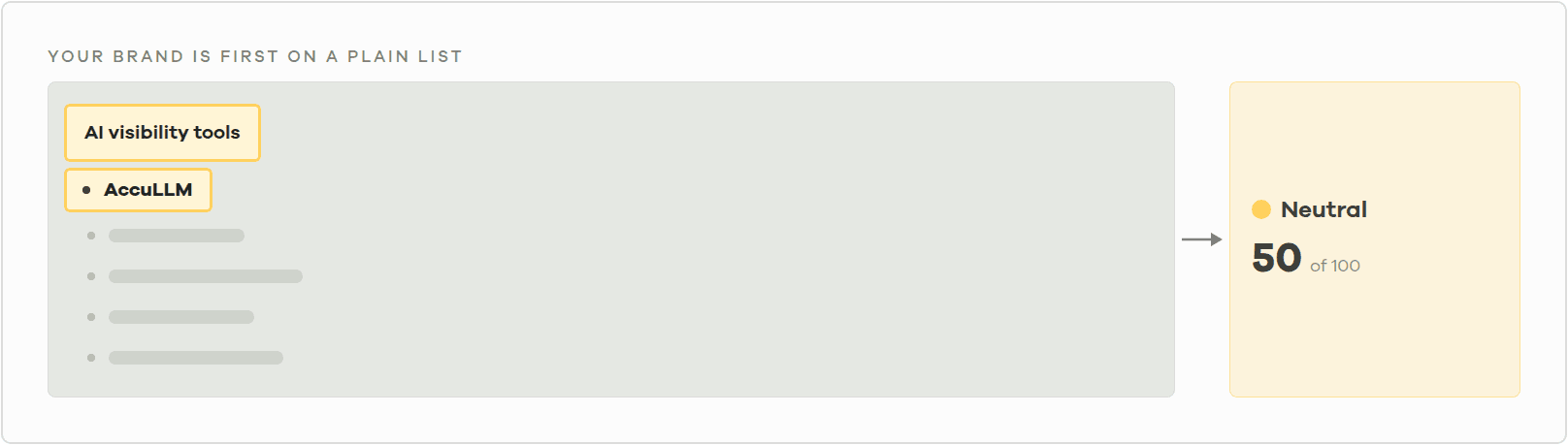
When your brand is on a list, we include the list's heading. If the heading does not say the list is ranked, even first place is neutral.
When the list is ranked, first place is positive and last place is neutral.
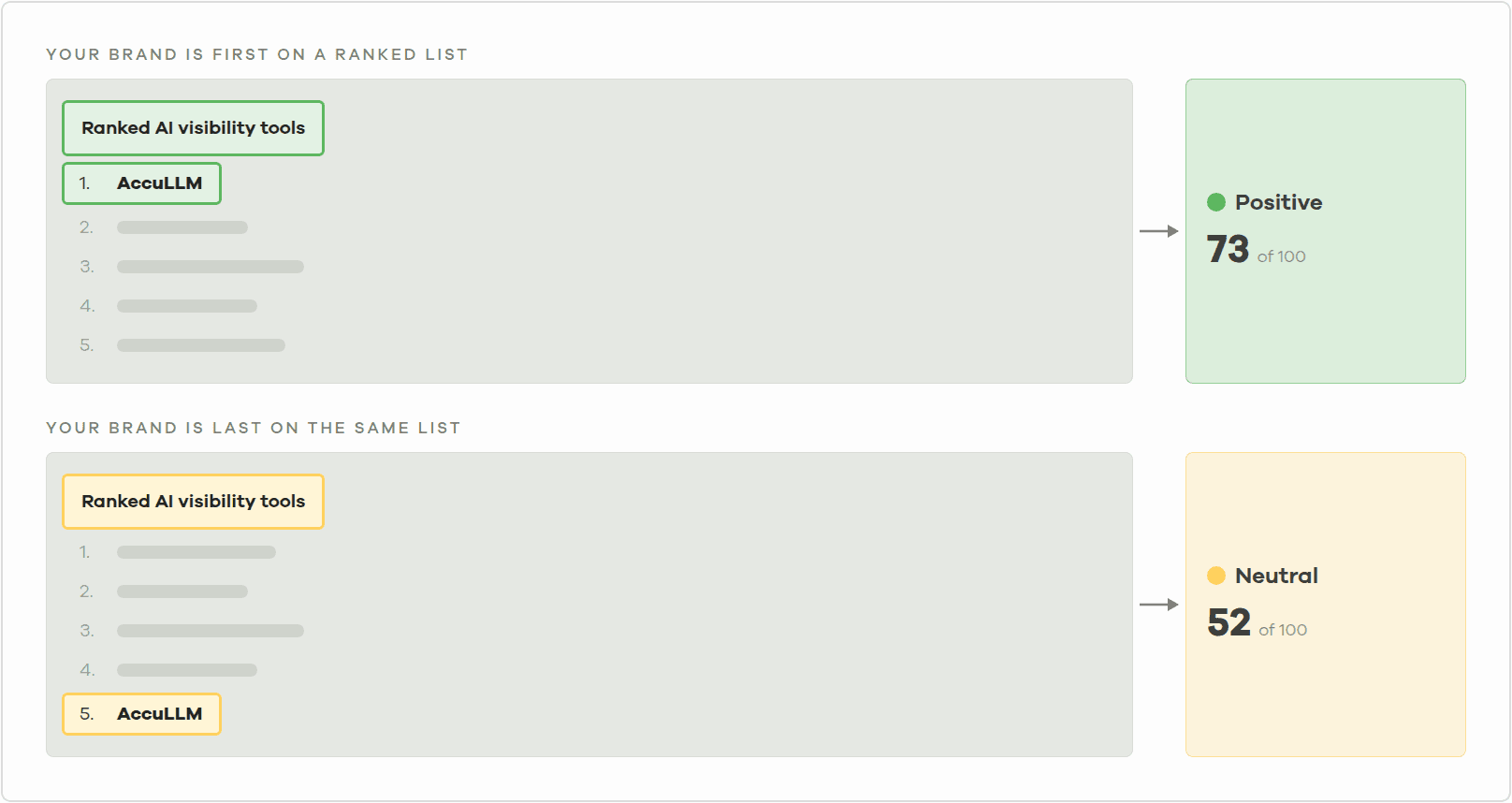
If the heading also carries praise, that praise counts too, and even last place is positive.
A list often names your brand on one line and describes it in the points below. We read those points too.
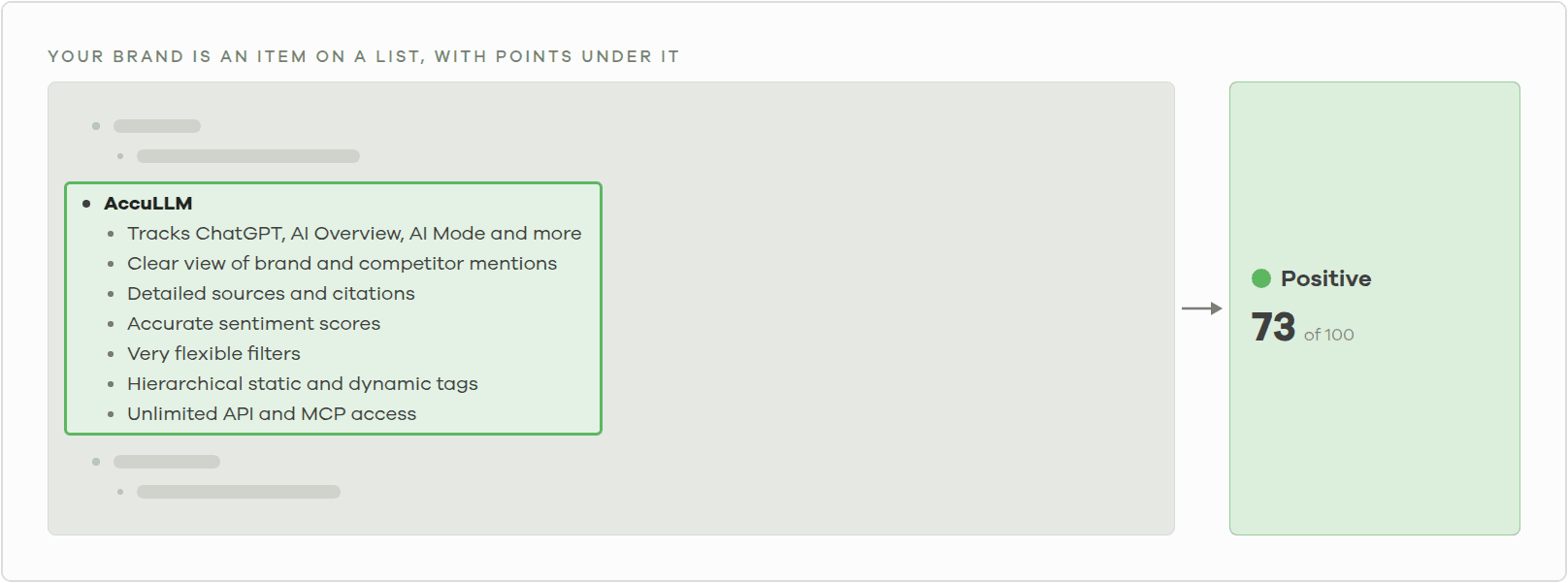
The line that names AccuLLM says nothing on its own. What the answer thinks of it is in the points beneath.
In a table, the header row does the same job as a heading.
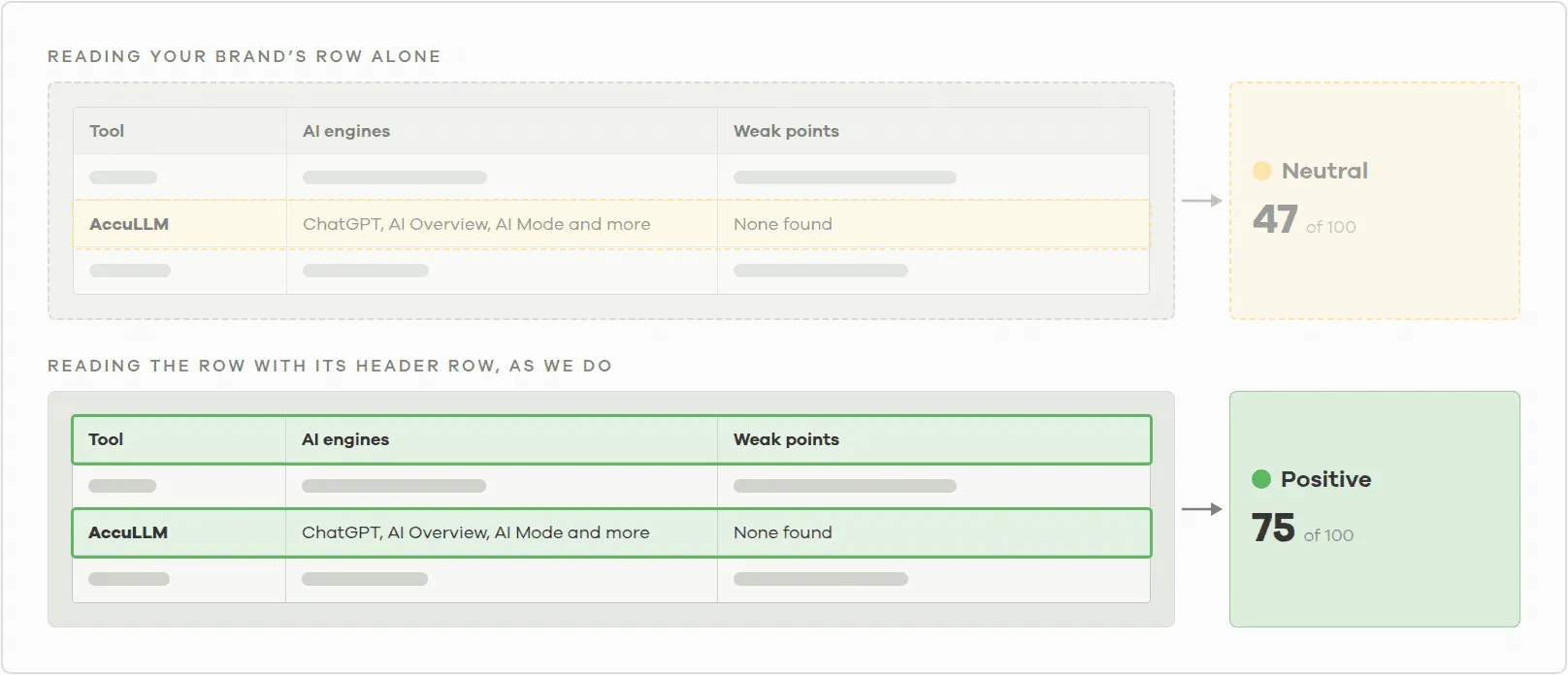
Read alone, "None found" says nothing about AccuLLM. Under the header "Weak points", it is praise.
Reading twice
Sometimes even that context is not enough. Without the whole answer, a passage can seem to say the opposite of what was meant.
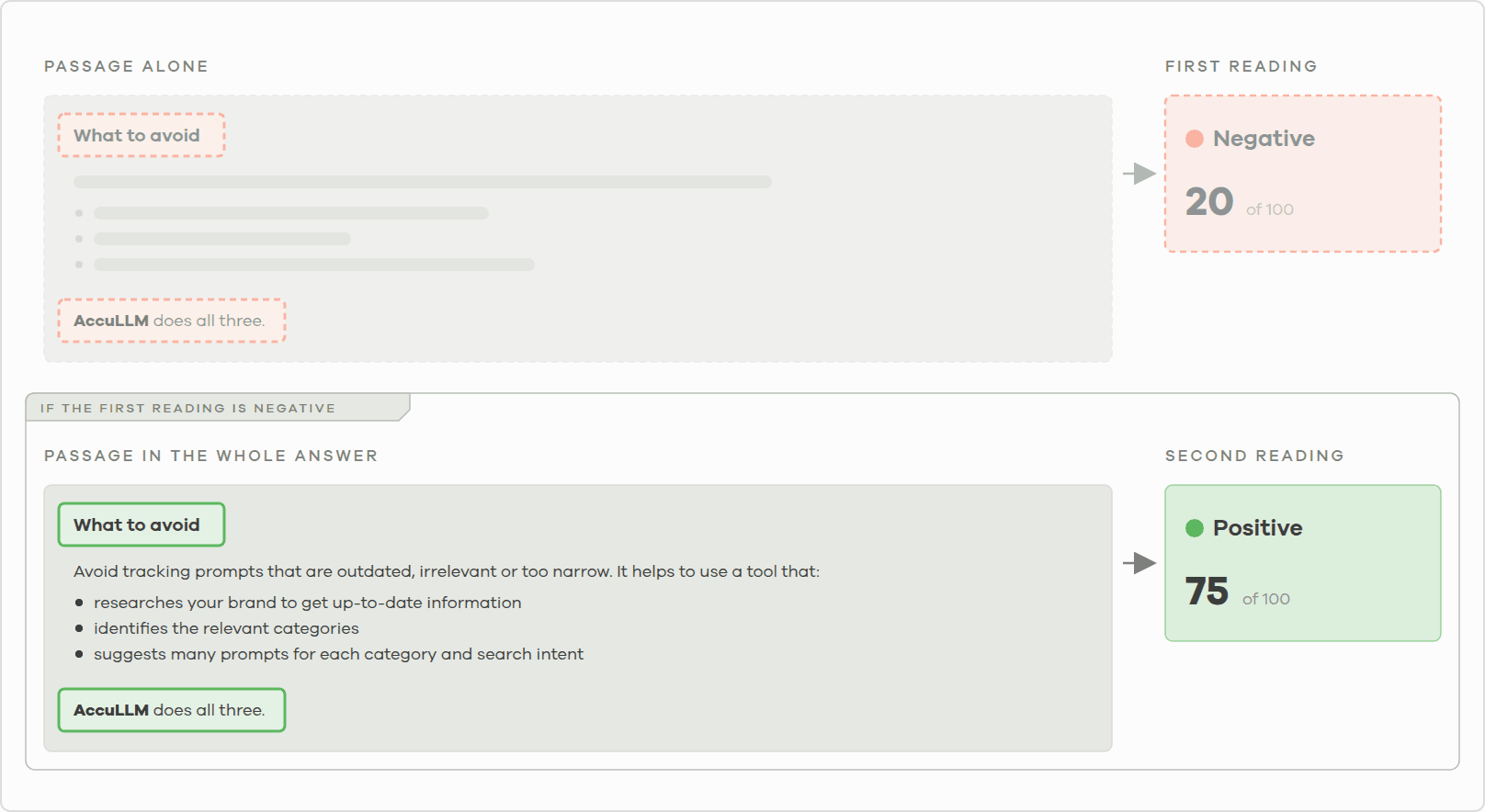
Read alone, the passage seems to say that AccuLLM does three things you should avoid. In the whole answer, "all three" turns out to mean the three things a good tool does, which happens to describe AccuLLM's prompt suggestions.
So when the first reading is negative, we read the passage again together with the whole answer. A passage is then scored negative only when it reads as negative both alone and in the whole answer.
You may wonder why we do not always read the whole answer. In our tests, that gave no better scores overall and more than four times as many wrong negatives: praise for another brand, or criticism of something else in the answer, pulled your own brand's score down (even though the answer made no comparison). The focused passage is also what we highlight in the app, so you can see the exact part of the whole answer your sentiment score is based on.
Accuracy
We measure accuracy by testing the scores against a large set of carefully labelled passages from real AI answers. We labelled them with state-of-the-art language models over many rounds. Each round was reviewed and corrected by hand before the next, with close attention to the nuances described in this post. Any measure of accuracy is only as good as the labels behind it, so we put a lot of time into getting them right and into making the set large enough.
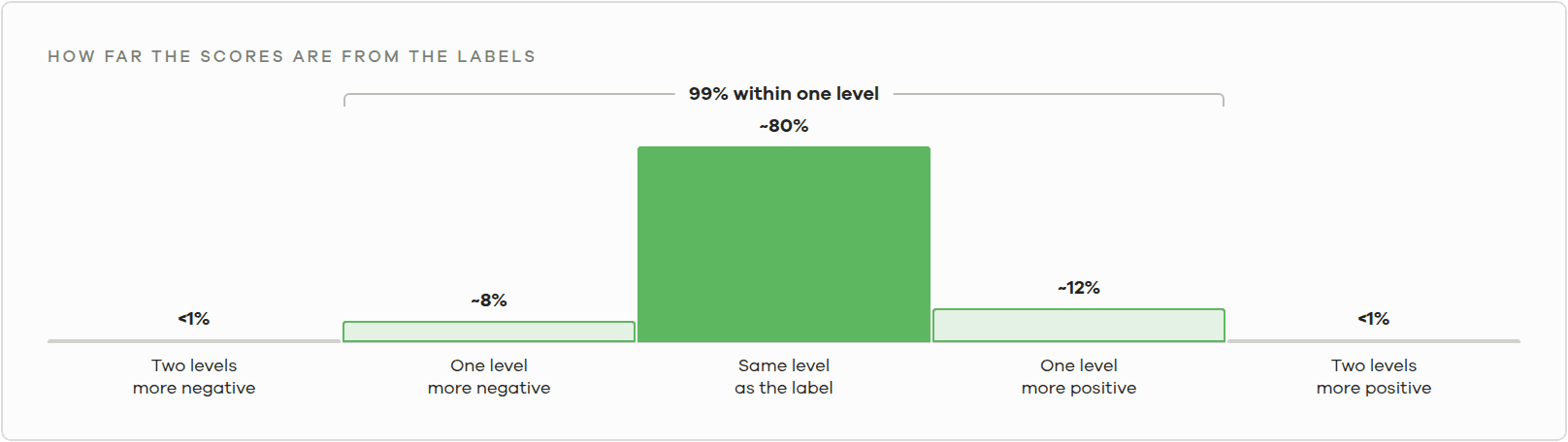
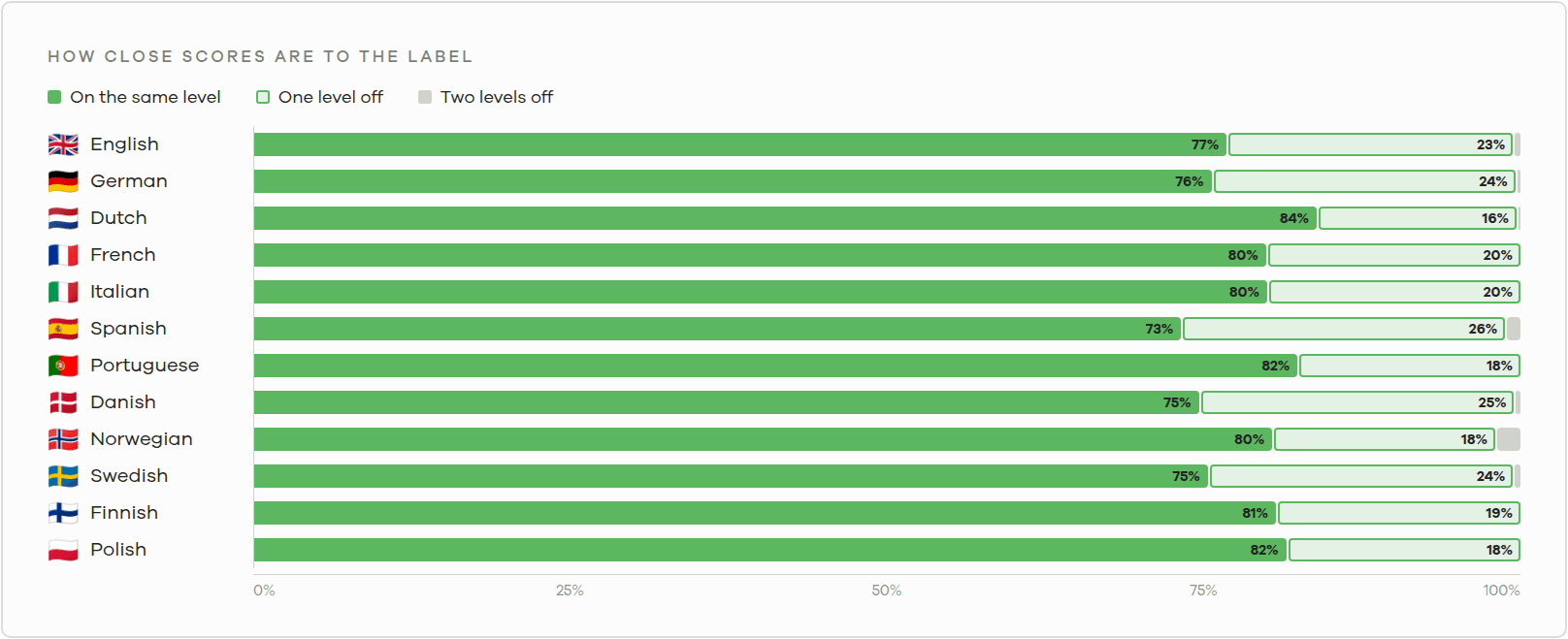
99% of scores are within one level of the label, up from 80% with the previous model. About four in five are on exactly the same level. The scores that are one level off are mostly among neutral, slightly positive, and positive. Most of them are close calls, where the score could have gone either way. Almost none are two levels off, and none are more than two.
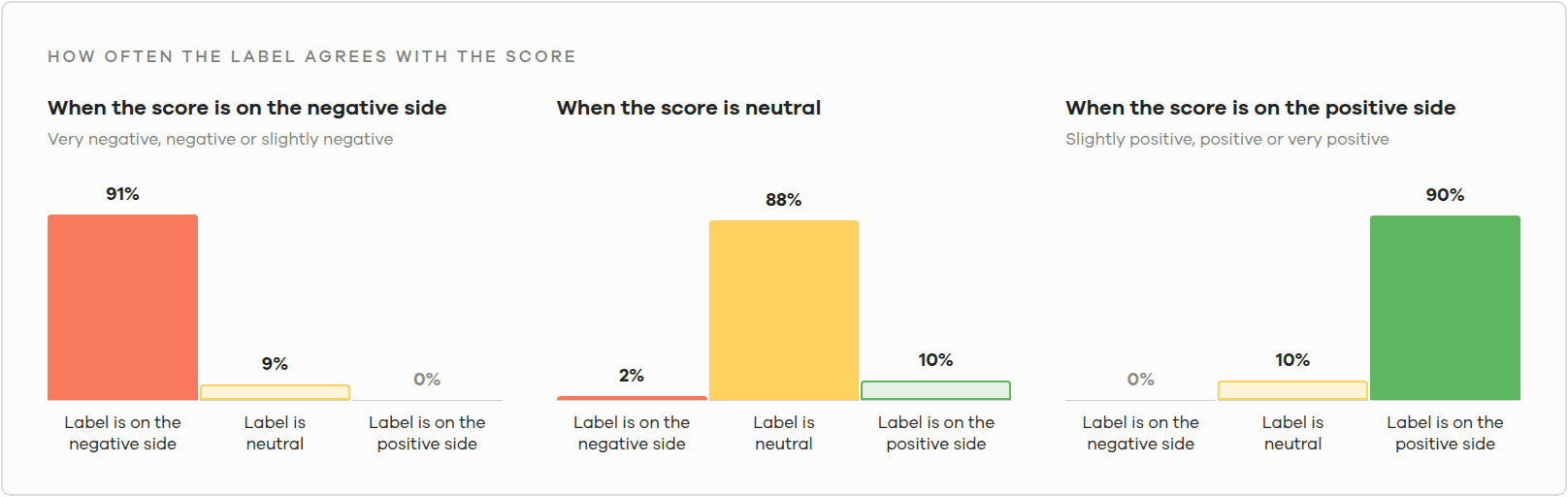
Grouped into a negative side, neutral, and a positive side, the score and the label agree about nine times in ten. When they differ, it is usually over whether a plain fact should count as praise or criticism, or when there is mixed sentiment. None cross between the negative and the positive side.
The scores are not fully deterministic, so there is slight noise, usually a point or two. That is only enough to change which of the seven levels a passage lands on where it was already a close call.
Across languages
About half the test passages are in English. The rest are in other European languages, such as German, Spanish, and Danish, and the scores are as accurate in each of them.
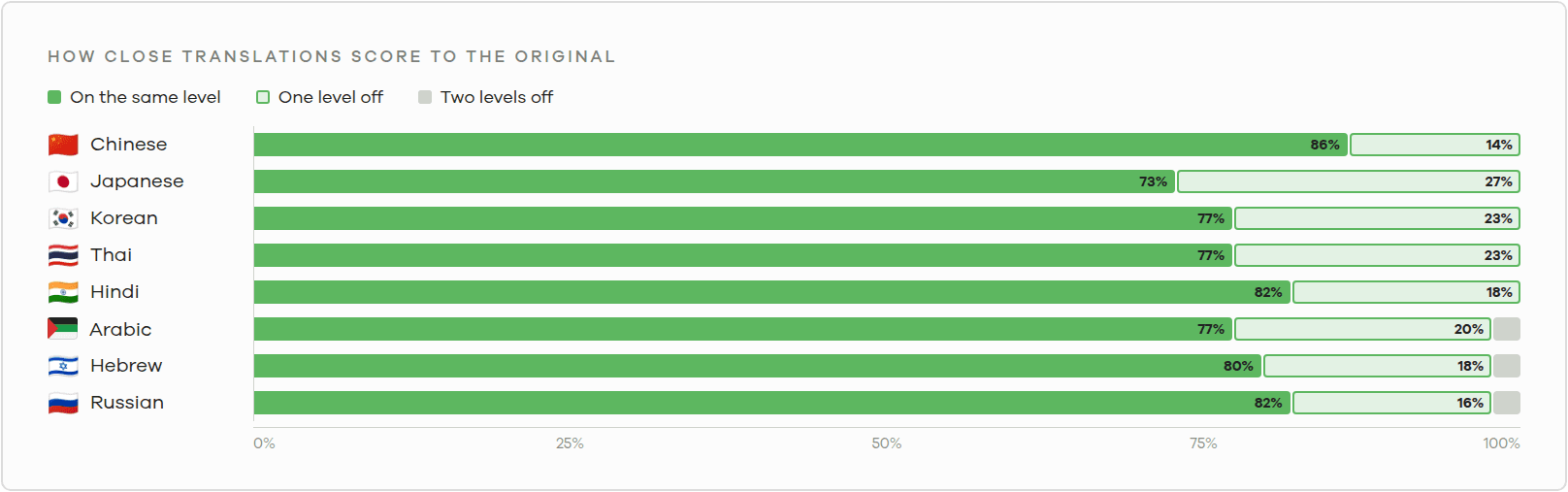
We also tested languages with non-Latin scripts, such as Chinese, Hindi, Arabic, and Russian, using passages translated from English. About four out of five translations score on the same level as the original, and nearly all of the rest are one level off. None cross between the negative and the positive side.
Related blog posts
How to Analyze Your Brand Mention in AI Responses
Being mentioned in AI responses is only the beginning. We give you 6 factors to consider when analyzing your brand mentions and AI visibility.
18 June 2026
How to Choose the Best AI Visibility Tool
Learn how to choose the right LLM tracking tool to monitor AI visibility. We go through key features, integrations, capabilities, and budget.
1 October 2026
From Setup to First LLM Insights in No Time
If you have not started tracking prompts yet, this is where to begin. We show you how to go from zero setup to first LLM insights in no time.
26 February 2026