

How AccuRanker Handles Poisoned SERPs

Peter Emil Tybirk
October 19, 2026
Google is serving poisoned SERPs. Explore our findings, how this affects ranking data, and how AccuRanker detects and handles the issue.
Since late September, the SEO community has been talking about "poisoned" or swapped SERPs: Google results pages that look normal but list a different set of organic results. Nozzle, Search Engine Roundtable, and several rank trackers have written about it, and many SEOs have seen sudden one-day drops in their ranking data.
We saw it too. On the first day, more than a quarter of the keywords in our monitored sample came back with a swapped page 1. Within two days, the AccuRanker team had brought that below 2%. In mid-October, stricter checks brought it under 1%.
Google tightened its detection again on October 15, mostly on mobile. This time our checks held most of it back, and by October 17 both devices were under 1% again. Google keeps adjusting, and so do we.
In this article, we cover what poisoned SERPs look like, how we catch them before they reach your dashboard, and how to spot them in your own data.
What Changed in Google's Search Results?
Late on September 24, we began receiving more and more unusual results from Google.
Rank trackers search Google automatically for specific keywords, locations, and devices to record where websites appear. This happens across millions of keywords.
Google appears to decide whether to show a poisoned SERP per browser session, not per keyword. Two searches for the same keyword at the same moment can get different pages. That is why poisoned SERPs follow how data is collected, not what you track.
Why Is Google Poisoning SERPs?
Several rank trackers and SERP data vendors reported similar behavior in September and October. Google has made no statement. One possible explanation is Google's effort against bulk scraping for AI answer engines, with rank trackers caught in the middle.
It did not start in September. From late January 2026, our stored rankings show smaller rounds of the same pattern, switching on and off by weekday and hitting local searches first. From April to July, they ran at about 7 to 10 times their 2025 level. September 24 was the big step, not the first one.
What Does a Poisoned SERP Look Like?
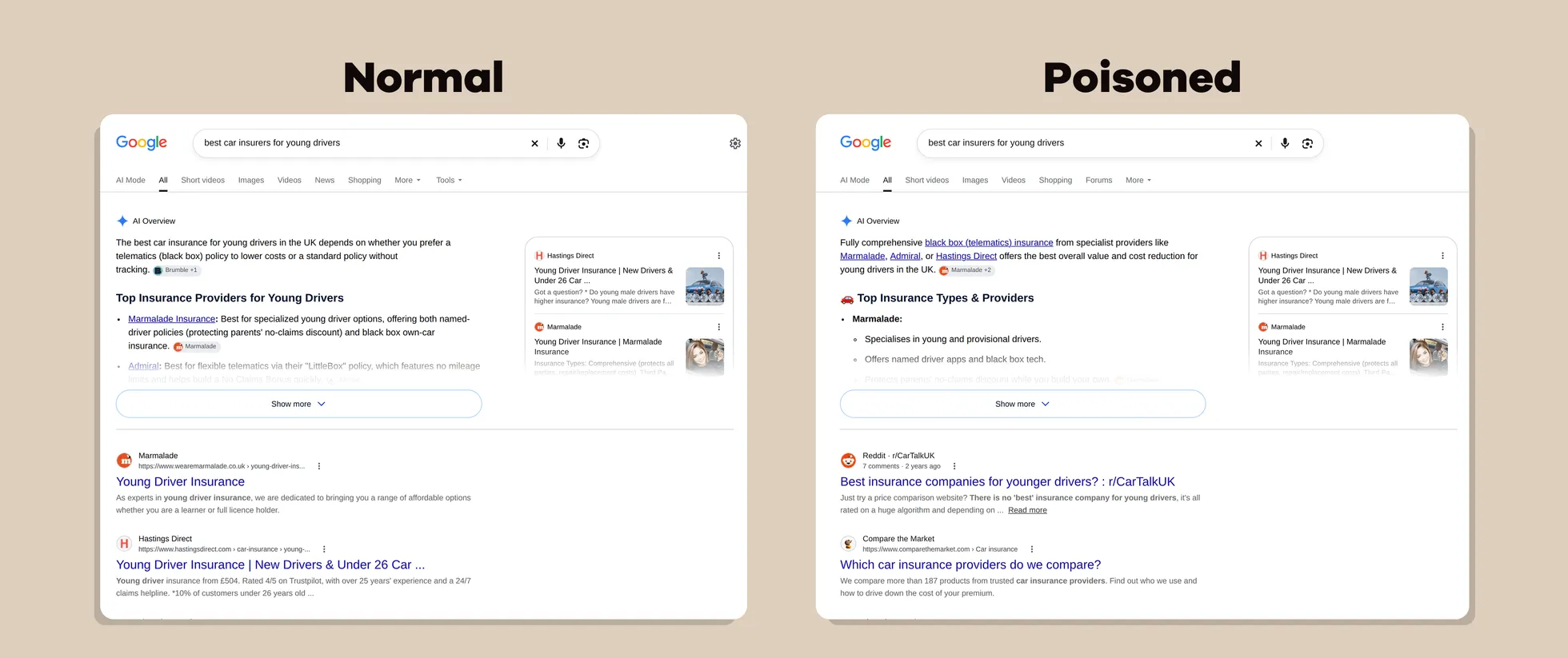
A poisoned SERP does not look suspicious on its own. You still see the familiar layout, ads, and AI Overviews. Only the organic listings are different.
It becomes clear when you compare the page with its history. Here is an example. The numbers are illustrative, but the pattern is what we see in our data.
| Day | Your site | Usual competitors in the top 10 |
|---|---|---|
| Monday | #3 | 9 of 10 |
| Tuesday | #3 | 9 of 10 |
| Wednesday | Not in the top 100 | 3 of 10 |
| Thursday | #3 | 9 of 10 |
On Wednesday, your site seems to have dropped out of the top 100, and most of your usual competitors are gone too. On Thursday, everything is back. Wednesday could send you looking for a penalty or a technical issue. In reality, the rank tracker may have received a poisoned SERP.
This is also how we measure poisoned SERPs. We count a page 1 as poisoned when its top 10 keeps fewer than half of the sites from the day before, and fewer than half from the day after. Wednesday in the example is such a day. We call this the sandwich check.
Whole-page flips like this were rare in 2025 (about 1 in 1,000 daily checks or fewer). So when you see one today, a poisoned SERP is the likely cause. For some keywords, Google has always rotated a few results between searches, and we see the same on a real device. That can push your site out for a day while most of the page stays the same. A poisoned SERP replaces most of the usual sites at once.
Cut-down SERPs and ignored locations
Poisoned SERPs come in two other forms.
Some pages are cut short: page 1 has few or no links to further pages, and the results stop after one or two pages. These are easy to spot. We reject them while we collect and fetch the page again with another session, so the cut-down page is not stored. Over a day in mid-October, this happened to about 2% of our desktop and 1% of our mobile requests. If a keyword keeps returning a short page after several attempts, we keep it, because some searches really do have few results.
On a local search, a poisoned page can ignore the location you track. It lists businesses from other cities, while the location line at the bottom of the page still names your city. Our check against each page's history (described below) catches these pages, because the usual local businesses are missing.
Are Certain Markets, Devices, or Keywords More Affected?
In our data, no market, device, or keyword type stands out.
Across 22 markets from late September to mid-October, the share of poisoned pages fell between 1.1% and 1.7% in every market. Desktop and mobile were both at about 1.3%. Local and brand keywords were slightly lower, but no keyword type was hit much harder than the rest.
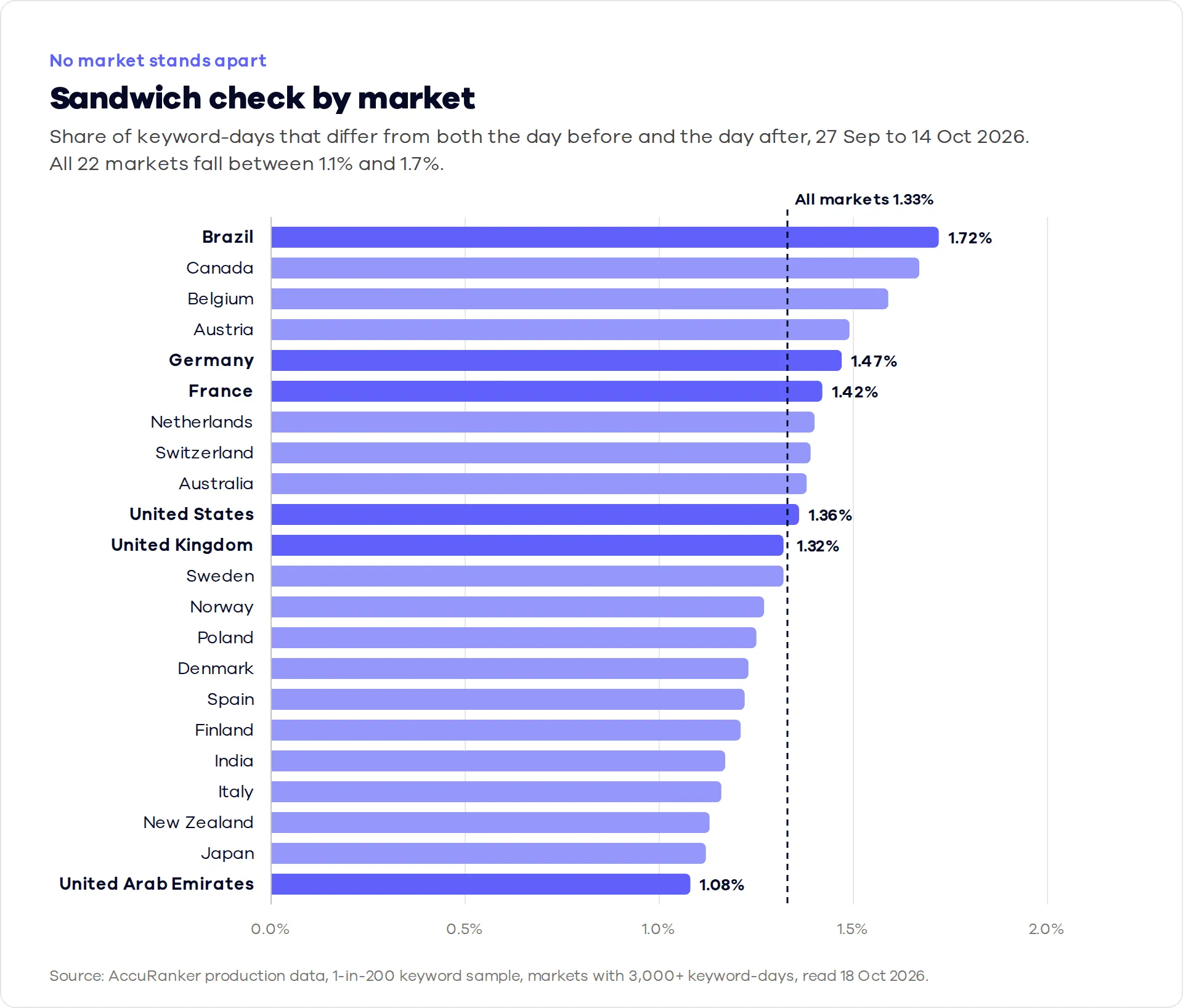 Every market falls between 1.1% and 1.7%, and no market stands apart.
This points the same way as above: poisoned SERPs follow how searches are collected, not the market, device, or keyword being tracked.
How Long Do Poisoned SERPs Last?
Most last a single day. More than 9 in 10 runs of poisoned days for a keyword last one day, and only about 2 in 100 last three days or longer.
When we fetch an affected SERP again with another session, the second fetch returns normal results about 3 times in 4.
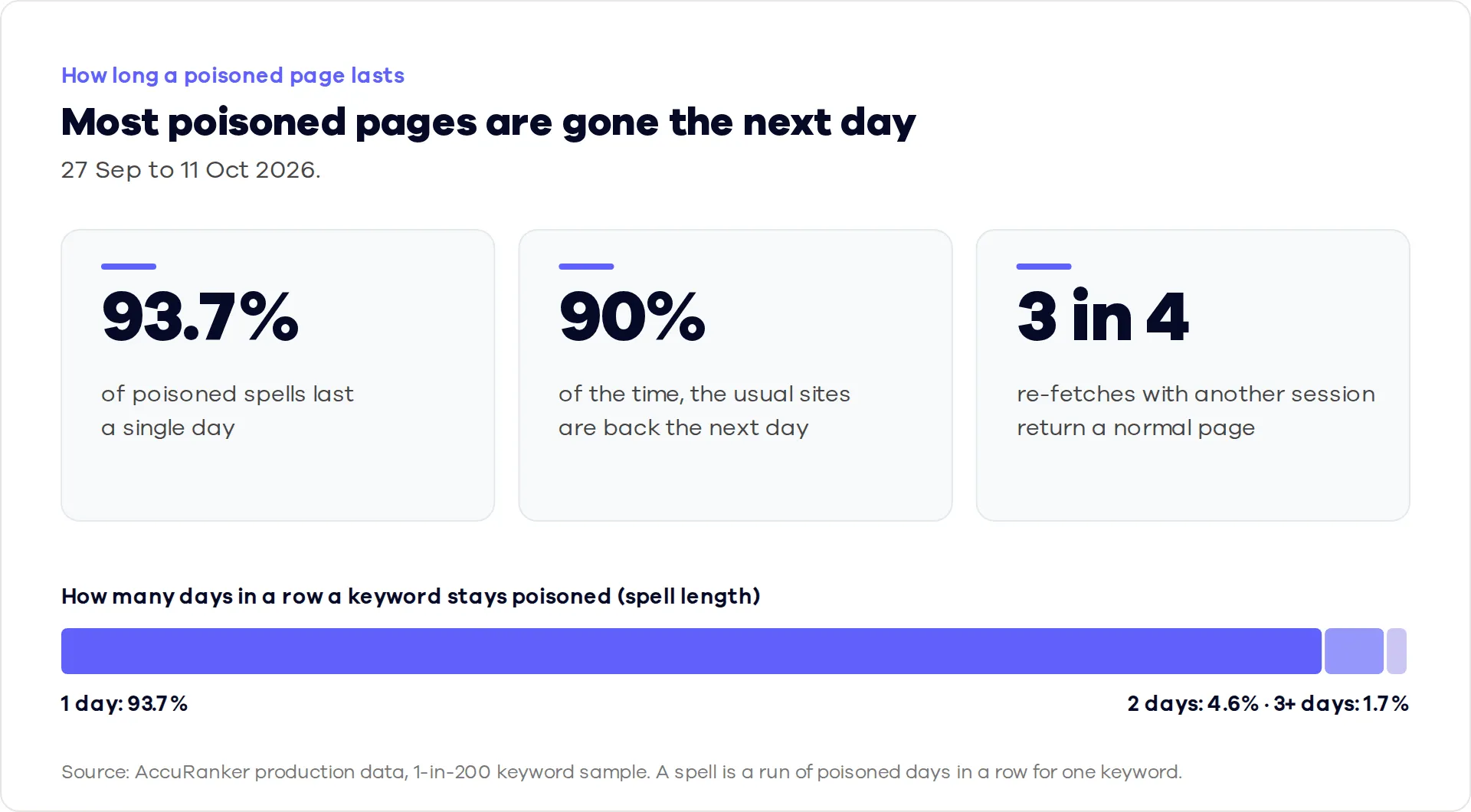
So if your site drops out of the top 100 and is back in its usual spot the next day, a poisoned SERP is the likely cause, not an SEO problem.
How We Detect and Handle Poisoned SERPs
We work in three layers.
1. Collecting cleaner data
We keep improving how we collect results. This is what brought the first-day spike under control within two days, and what took most of the mobile rise back out after October 15. It lowers the rate but does not bring it to zero, so we also check the result.
2. Checking each page before it is stored
First, we reject any cut-down page and fetch it again with another session. Then we compare page 1 with its history: the sites the keyword showed on page 1 on at least two of the last three days. That way, one unusual day cannot redefine what a normal page looks like.
- If at least half of those sites are still there, we store the page.
- If fewer than half remain, we fetch the page again with another session. If the second fetch matches the history, we store that.
- If the second fetch also shows the new sites, two sessions agree. That is a real change in Google's results, and we store it.
So a real new competitor still reaches your dashboard the same day.
The history check does not cover every page yet. About 1 in 20 desktop pages and 1 in 12 mobile pages have too little history to compare, for example a new keyword or one that comes back after a break.
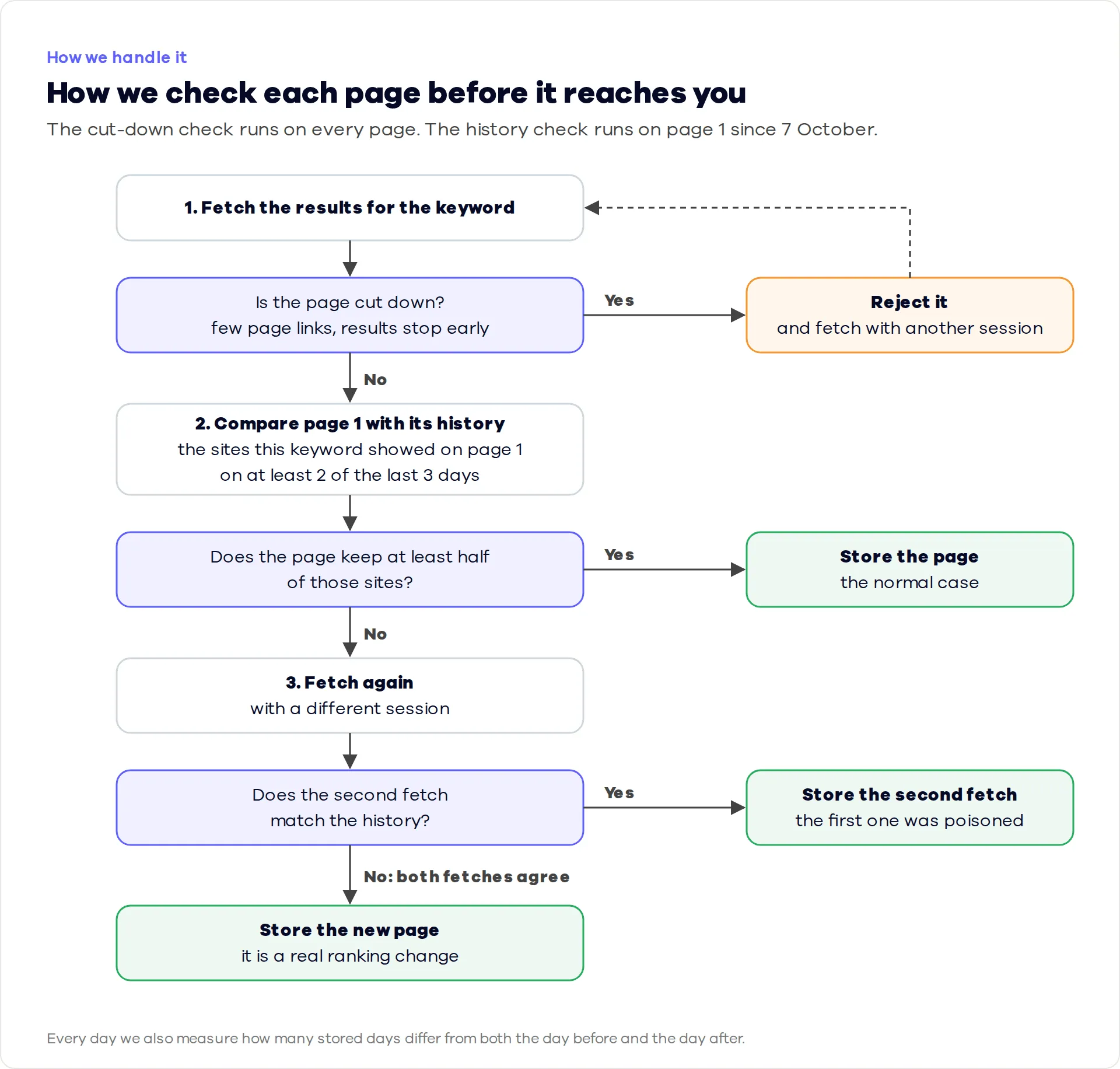 A cut-down page is rejected at once. When the history check applies, a page that loses most of its usual sites gets a second fetch before anything reaches your dashboard.
3. Monitoring what we store
We also check the data after it is stored, with the sandwich check described above. A day that disagrees with both neighbors is rarely a real ranking change.
How Much Has Google’s SERP Poisoning Affected AccuRanker?
The table shows the sandwich check for poisoned SERPs on a fixed sample of our tracked keywords.
| Period | Sandwich check, desktop | Sandwich check, mobile |
|---|---|---|
| Before the onset, September 10–16 | 0.26% | 0.38% |
| First day, September 25 | 30.2% | 25.7% |
| Second day, September 26 | 4.5% | 4.0% |
| October 1–9 | 1.47% | 1.47% |
| October 10–13 | 0.97% | 1.21% |
| October 14, stricter re-check | 0.68% | 1.04% |
| October 15 | 0.33% | 0.57% |
| October 16, after Google's next step | 0.69% | 2.55% |
| October 17 | 0.58% | 0.47% |
After the first two days, the share stayed around 1–2% a day. Stricter checks from October 14 brought it lower again. We are not back at the level from before the onset, but we are getting close.
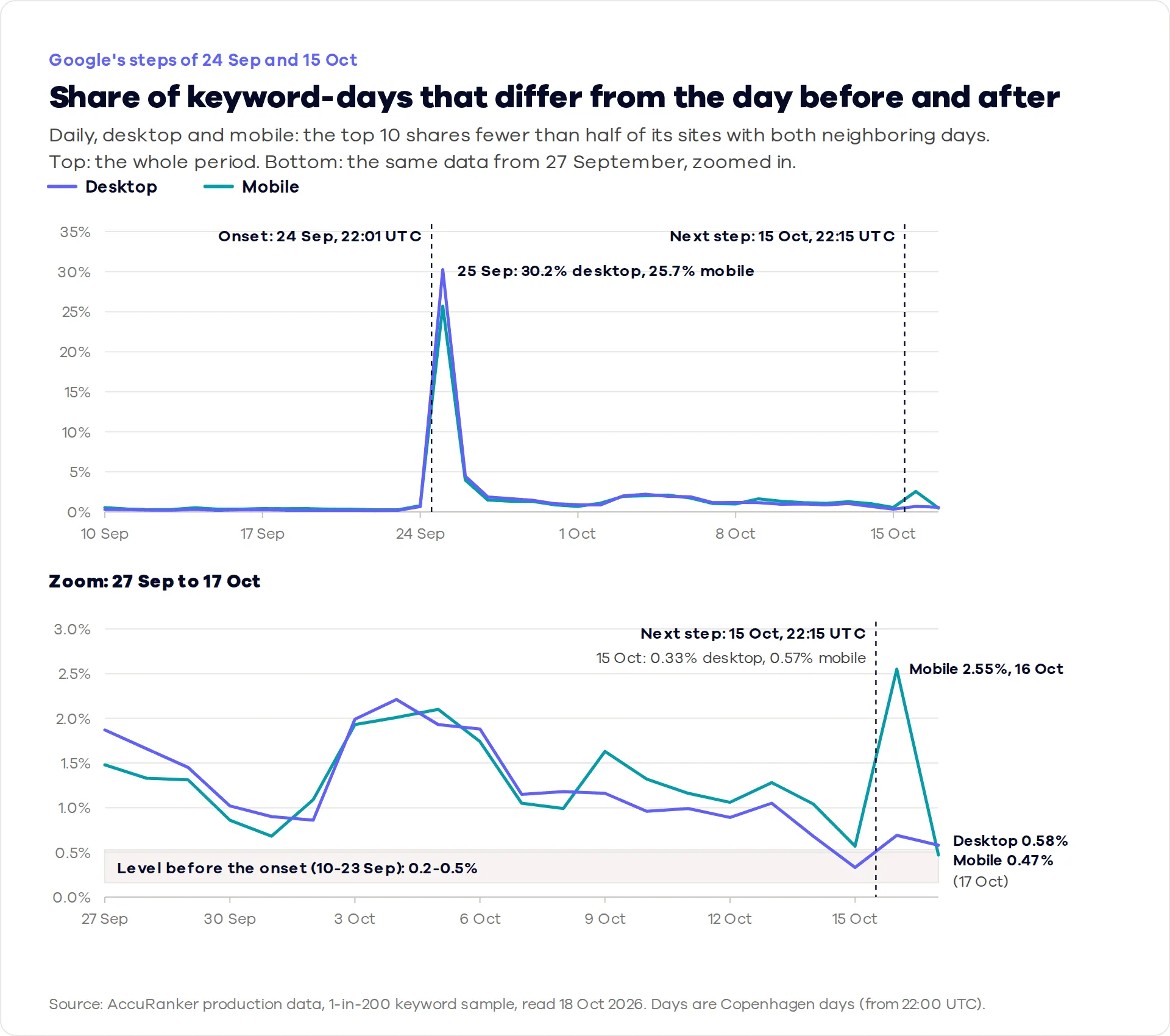 The sandwich check from September 10 to October 17, with Google's steps of September 24 and October 15 marked.
Google's next step on October 15
Late on October 15, Google tightened its detection again. The change hit automated Android sessions hardest. Desktop moved much less for us, although there are indications that they also tightened their detection for desktop.
This time, our checks held most of it back. On October 16, under 3% of our mobile keywords failed the sandwich check, against more than 25% on the first day in September. We changed how we collect mobile results overnight, and by October 17 the mobile share was our lowest since the onset.
The change is on Google's side, so other rank trackers and data providers may see it too. If your rankings show sudden drops from October 16, the checklist below can help.
What About AccuSERP?
AccuSERP, our SERP API, returns the page Google sends for a single search. Without a keyword's history, it cannot run the history check. But AccuSERP and AccuRanker share the same pool of browser sessions. AccuRanker checks a session before AccuSERP gets it, and AccuSERP first uses sessions that have passed that check and stayed clean since. What we learn on AccuRanker goes into how AccuSERP collects its pages too.
What About Page 2 and Beyond?
Pages 2 and beyond have a different but related problem. There, Google sometimes answers a different question than the one you asked, with results for only one word of the query. SerpApi has tracked the same pattern in a public issue since May. We will cover it in a separate article soon.
How to Spot Poisoned SERPs in Your Ranking Data
Before you act on a sudden drop, check these six things:
- Look for drops that reverse the next day: A one-day drop out of the top 100 that is back the next day is most likely bad data, not a penalty.
- Check the other websites on the same SERP: If many of your usual competitors vanish on the same day, suspect the data.
- Review local search results: Businesses from the wrong town are a sign of a poisoned page.
- Check Google Search Console: Filter the Performance report by the same query and date. If your average position and clicks did not drop that day, the drop in your rank tracker was most likely a poisoned page.
- Look at trends across days: Do not react to one day.
- Ask your rank tracker: Ask how it detects poisoned pages, what share of its stored data is poisoned, and whether it re-checks a page before it reports it.
Where This Leaves Us
Google has made no statement about how long this will last. We keep watching our data and will keep adjusting how we collect and check pages as Google changes its behavior.
In the meantime, we reject cut-down pages as we collect them, check page 1 against its history before it reaches you, and give a page that fails the check a second fetch.
A sudden ranking drop is not always a real change in your SEO performance. If a day looks strange, go through the checklist above before you act. If it is in your AccuRanker data, trigger a refresh of that keyword in the app. The refresh fetches a new page with another session and will most likely fix it.
If you want ranking data you can trust, request an AccuRanker demo, or get your AccuSERP API token to get Google results in your own tools.
Methodology and Data
For readers who want the details.
How we measure
We monitor a fixed sample of 1 in every 200 tracked keywords. A keyword-day is one keyword checked on one day. Most numbers in this article use the sandwich check. Most poisoned pages last a single day, so they stand out from both neighbors. A real ranking change usually stays, so the next day agrees with it. The check needs only one later day, so it can also judge the newest days.
For how long poisoned pages last and for keyword types (September 27 to October 11), and for the comparison with Nozzle, we used Nozzle's rule instead.
Compared with Nozzle
Nozzle published its daily numbers and its method. For each keyword, its rule lists the sites that appeared in the top 10 on at least 60% of days in a base period. A day counts as poisoned when fewer than half of those usual sites appear anywhere in the results and they return later.
We applied our reading of the rule to our data, with the same base period (August 20 to September 9). From October 1 to 9, the last day Nozzle has published, our share averaged 1.5% a day, about a fifth of theirs. Nozzle's rate peaked at 27% on September 29, when ours was 1.4%.
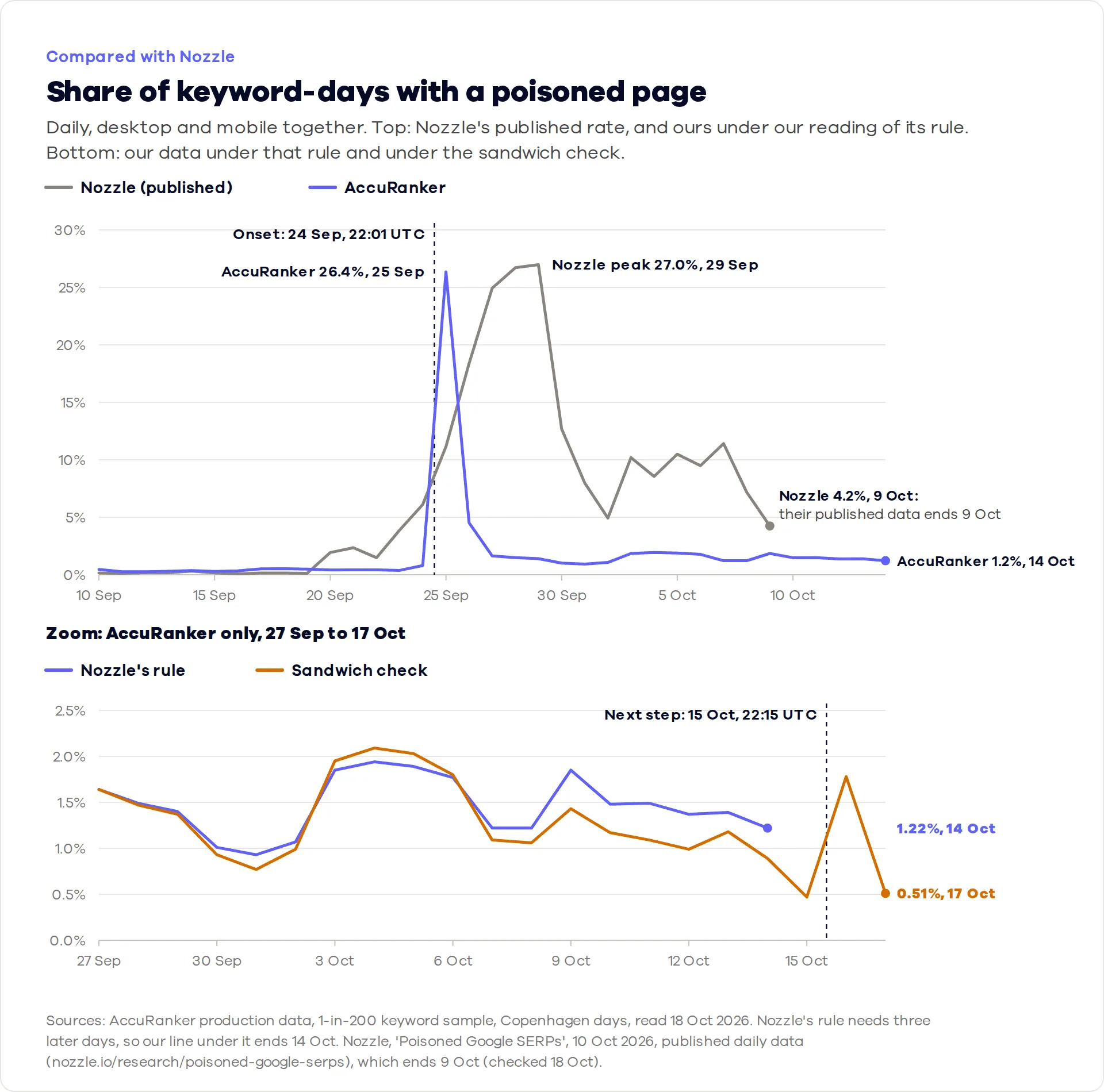 Top: under the same rule, Nozzle's published rate peaked at 27% on September 29, while ours stayed below 2%. Nozzle's published data ends on October 9. Bottom: our data under Nozzle's rule and under the sandwich check.
The two measures treat a run of days differently. If the usual sites are missing for two or more days in a row and come back within 14 days, Nozzle's rule counts each of those days. If those days show the same new sites, the sandwich check counts none of them, because each day agrees with its neighbor. Such a run can be a real change that lasts a few days, or poisoned pages that repeat.
On our data, the two measures read almost the same until early October (about 1.5% on both devices). From October 7 to 14, Nozzle's rule read a little higher (about 1.3–1.5% against 1.0–1.2%).
Nozzle's rule also spreads our markets wider (about 0.8% to 2.4%, against 1.1% to 1.7% under the sandwich check). Under that rule, our highest markets are France and Germany, both among Nozzle's lowest. Our lowest, New Zealand, is among Nozzle's highest. If the country itself were the main factor, we would expect the same countries near the top of both lists. Under the sandwich check, France and Germany sit close to the average.
Download the data
The daily numbers behind this article are free to download as one CSV file. It has a row for each day from September 10 to October 17, 2026, for desktop, mobile, and both together. The column sandwich_share_pct holds the sandwich check, and poisoned_share_pct holds the share under Nozzle's rule. Dates are Copenhagen dates.
Nozzle's rule needs three later days, so that column is empty for October 15–17. A day's value under that rule can still rise a little until 14 later days are in.
You may use the data with the credit "Source: AccuRanker" and a link to this article (CC BY 4.0).
Related blog posts

Google Num 100 Update
19 September 2025
New Share of Voice: What Changes on October 21, 2026
Our Share of Voice is changing. See what is new, why we updated Dynamic CTR, and what to expect from your data when the changes go live.
7 October 2026
A New Dynamic CTR Model Built for Today’s SERPs
Learn why we rebuilt our Dynamic CTR model and how it delivers more accurate CTR estimates based on real click behavior and today’s SERPs.
7 October 2026