


How to Predict Traffic, Revenue, and ROI with SEO Forecasting

Sille Christensen
September 24, 2026
Learn how SEO forecasting helps you predict potential traffic, revenue, and ROI, build realistic scenarios, and make a stronger case for SEO.
“So what will we actually get from SEO?” There it is. The big question every SEO knows is coming from a stakeholder or client.
You can talk about rankings, visibility, and keyword opportunities all day. Eventually, someone wants to know what all that SEO goodness could mean for traffic, revenue, and ROI. And that is where SEO forecasting comes in.
What Is SEO Forecasting?
Forecasting estimates the potential business impact of your SEO strategy. You take what you know about rankings, search demand, clicks, and conversions, and use it to model what that means in financial returns.
Could being more visible generate another 20,000 visits? What could those visits be worth? Would investing more money in SEO make sense? Now we are talking.
The goal is not to predict exactly what will happen. Nobody can do that, especially when Google has a habit of rearranging the furniture once in a while. The goal is to create a realistic picture of what SEO could achieve and give stakeholders something to make decisions from.
How to Build an SEO Forecast
You can create your forecasts directly in the AccuRanker app, whether you are planning a project with a handful of keywords or a large-scale strategy covering thousands. You can track your progress against it to see whether your SEO efforts are delivering the expected impact or whether it is time to adjust the plan.
Getting started only takes three steps:
- Define financial settings: Set your monthly investment, average conversion value, and average conversion rate.
- Add keywords: Choose your preferred keywords and confirm them.
- Set rank targets: Determine your keyword rank targets using different strategies.
AccuRanker takes your input and turns it into a visual forecast of business impact, including ROI, traffic, and revenue. You can then show stakeholders what your efforts are actually worth.

Why Traditional SEO Metrics Derail Your Forecast
You can set perfectly reasonable ranking targets and build a beautiful forecast. But if your SEO tool relies on misleading search volumes and an outdated CTR model, those inaccuracies travel straight into your estimated traffic, revenue, and ROI. And suddenly, your realistic forecast is not so realistic anymore.
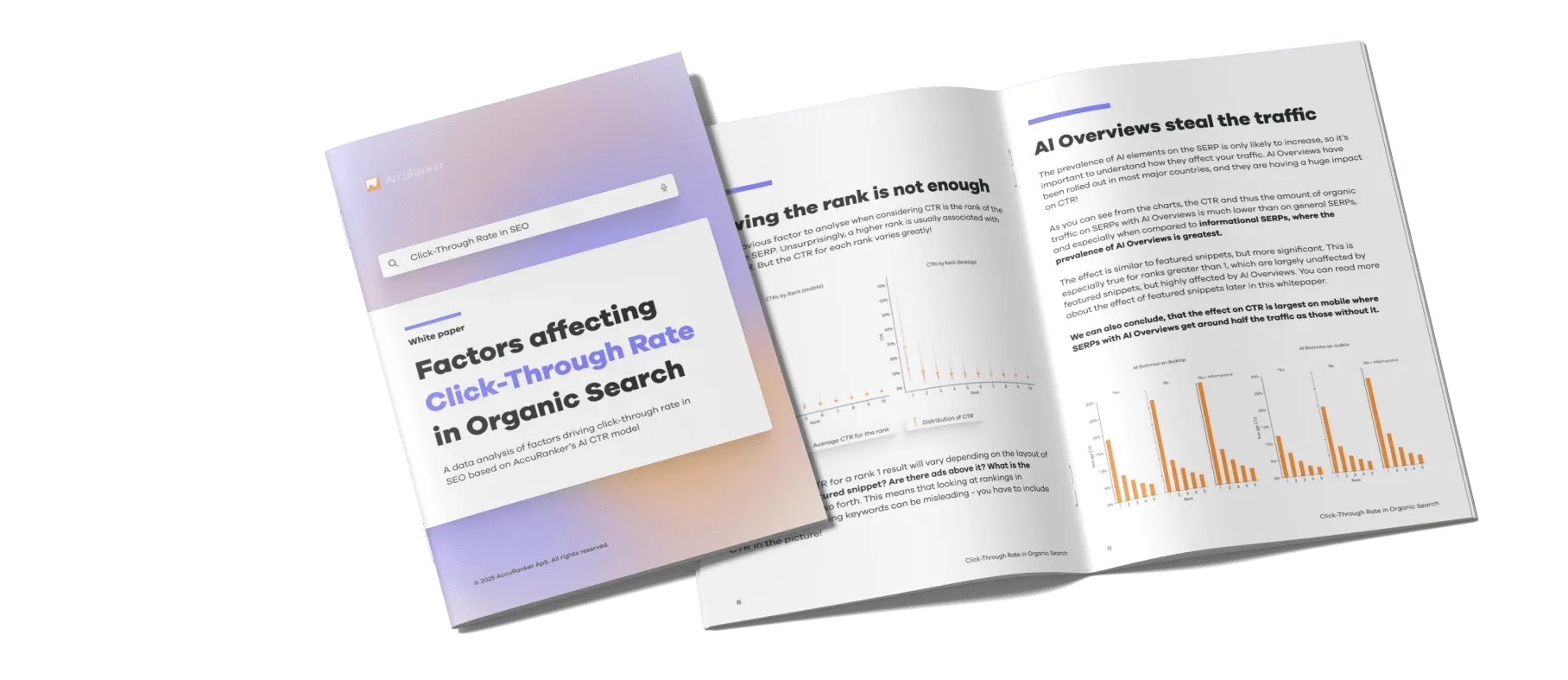
Take CTR. Many SEO tools still rely on a static CTR model that assigns an average click-through rate to each rank. But rank 1 does not always behave like rank 1. Ads, AI Overviews, featured snippets, search intent, and the like all influence how many clicks your result actually gets.
AccuRanker’s dynamic CTR accounts for more than 120 parameters, including SERP features, pixel position, and search intent to calculate a keyword’s expected CTR. It gives you a more realistic picture of the traffic potential behind your rankings, rather than assuming every SERP plays by the same rules.
Search volume has a similar problem. Some search volume sources group related keywords and reports inflated and fluctuating numbers, simply failing to reflect the actual demand for a keyword. And if your tool thinks more people are searching than actually are, your forecast starts promising traffic that was never there in the first place.
Our AR Search Volume combines data from Google Keyword Planner, Google Search Console, and Google Trends to provide more reliable numbers. You get keyword-specific estimates, split by mobile and desktop searches, and adjusted for local intent.

Our metrics ensure your forecast is backed by a more precise picture of how many people are searching and how likely they are to click your rankings. And when the SEO data behind your forecast is more accurate, you have a much better chance of forecasting numbers that reality can actually recognize.
Why You Should Use Scenarios
SEO rarely follows a perfectly straight line, so your forecast should not either. That is what scenarios are for. They let you understand different outcomes instead of betting everything on one precise number.
In AccuRanker, we have two scenarios: conservative and aggressive. A conservative scenario shows what happens if you do not fully reach your ranking targets, while an aggressive scenario shows what happens if you exceed them.
Why use both, you might think. Because presenting one exact forecast implies that you somehow know precisely what Google, your competitors, and millions of searchers will do. But nobody does.
A range is more honest and more persuasive. It shows that you have thought carefully about the variables, which builds more trust than choosing one number and hoping reality cooperates.
When to use conservative vs. aggressive scenarios
Both scenarios have their place, and which one you lead with depends on the situation.
Lead with the conservative scenario when you are still building trust, the client or stakeholder is risk-averse, or you are competing in a space where progress is likely to take time.
Lead with the aggressive scenario when you want to show the full upside, have strong historical data supporting faster progress, or are making an internal case for increased investment and need to show what is possible.
Better yet, show both. Explain what separates them, and let the decision-maker choose which to plan around.

Turning a Forecast into a Stakeholder Conversation
When you present your forecast to stakeholders, start with the business outcome. Do not open with “we are targeting 15 keywords in positions 1–5.” Save that for the SEO team. Open with “this campaign is projected to generate between 90,000 and 150,000 in attributable revenue over 12 months.” Now you have their attention.
Explain how you will get there by showing how ranking improvements translate into traffic, conversions, and business value. Keep the SEO mechanics in the background and focus on what the numbers mean for the business.
This way, you create a shared language and understanding with stakeholders, where SEO performance is discussed in the terms that matter to them.
Do Not Forecast and Forget
Do not treat your forecast as something you build to win approval, then put it away and never look at it again. Because if someone digs it up six months later and asks why the numbers look different, you need a better answer than “well, that was just a forecast.”
Instead, once the work starts, compare your actual performance against your forecast and bring it up in reviews. If you are ahead, you have a way to demonstrate the additional impact of your SEO efforts. If you are behind, the gap gives you something to investigate. Maybe rankings are improving more slowly than expected?
Tracking your progress against the forecast creates transparency. You can openly explain deviations rather than hide them, and adjust your strategy accordingly. That honesty builds credibility with stakeholders and keeps the conversation focused on what to do next rather than who was wrong.
Because you are not trying to prove that you can predict the future. Your goal is to turn SEO potential into an honest business case that stakeholders can understand, evaluate, and make decisions around.
Forecast SEO with Data You Can Trust
SEO forecasting is not about promising to generate exactly 123,648 organic visits in 3 months. Search does not cooperate that nicely (unfortunately). A good forecast is about combining realistic assumptions with reliable data, acknowledging uncertainty, and showing different outcomes. That is what builds trust in stakeholder relationships.
Related blog posts
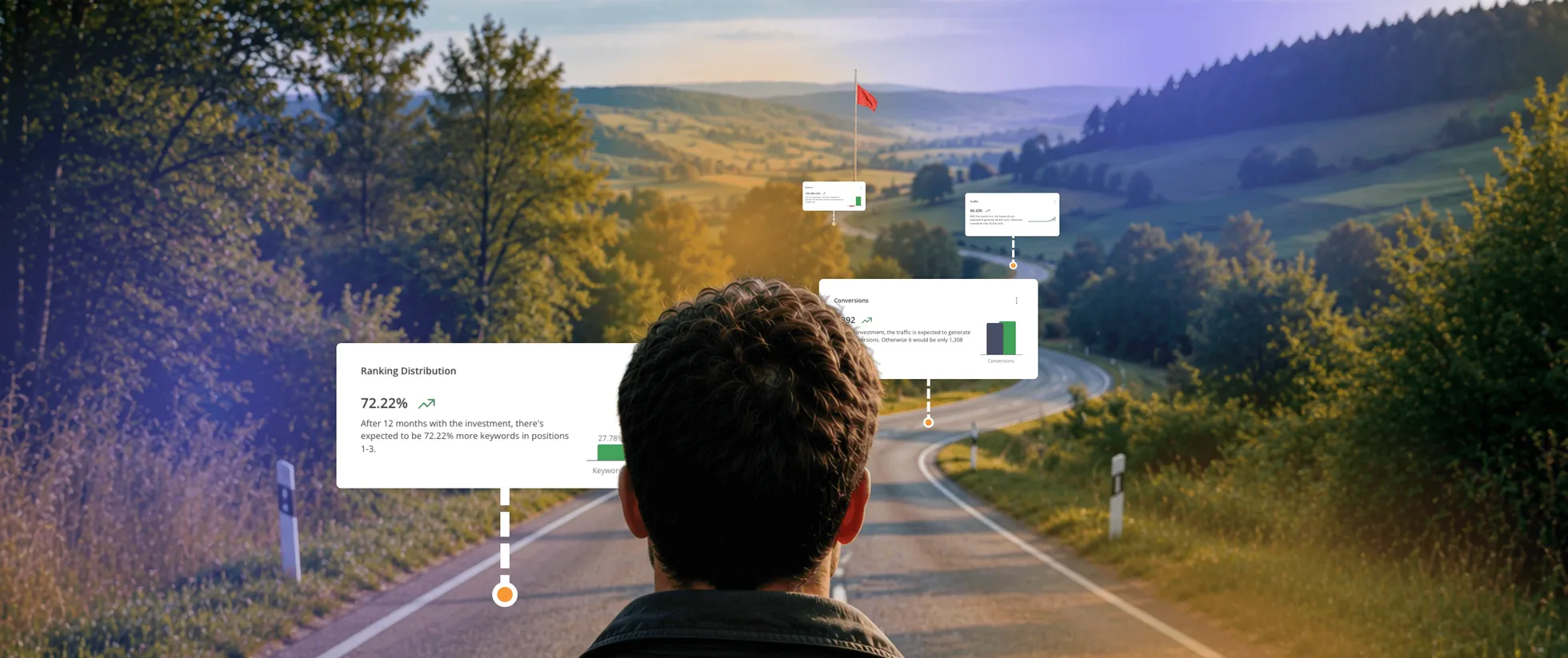
Get Buy-In with AccuRanker's SEO Forecasting
Learn how AccuRanker's new forecasting feature helps you predict the impact of your SEO efforts and make a case for your SEO projects.
1 March 2025
Why Your CTR Model Is Betraying You
A static CTR model relies on fixed averages. AccuRanker's dynamic CTR model accounts for 120+ factors to calculate a keyword's expected CTR.
2 June 2026
The Hidden Flaws in Search Volumes and How to Solve Them
Learn how AI Search Volume delivers reliable search volumes by combining GKP, GSC, and Trends so that you can prioritize the right keywords.
30 March 2026