

What Our Latest Data Reveal about AI Overviews
Sille Christensen
November 5, 2026
Discover what our latest data reveal about AI Overviews in 2026, including when and where they show up and their impact on organic CTR.
AI Overviews (AIOs) have made themselves comfortable on Google’s SERPs. But they are no longer staying in their usual corner. They are showing up in commercial and transactional searches and changing seats on the SERP like it is a game of musical chairs.
Drawing on 674 million matched observations from AccuRanker and Google Search Console collected between January and September 2026, we have examined the latest trends in AIO presence, CTR, and placement.
Let us explore what our latest data tell us about the current state of AIOs and what it means for you.
AI Overviews Are Becoming the Norm on Google
If you feel like AIOs are popping up everywhere, you are not imagining things. Our latest data confirm that the SERP feature has become a regular part of the Google search results we track.
On September 30, 2026, AIOs appeared in 66% of tracked desktop results and 59% of tracked mobile results. Just two months earlier, those numbers were 48% and 38%, respectively.
And Google is not exactly giving SEOs time to catch up. September saw particularly rapid growth, with AIOs appearing on an increasingly diverse range of searches.
AI Overviews Are Moving Into Commercial and Transactional Searches
Until recently, informational searches were the natural home of AIOs. Ask Google how to fix something or understand a concept, and an AI-generated answer will most likely greet you at the top of the page.
But AIOs are no longer sticking to familiar territory.
Our September data shows that AIOs grew across all four search intents, with remarkable increases in commercial and transactional searches.
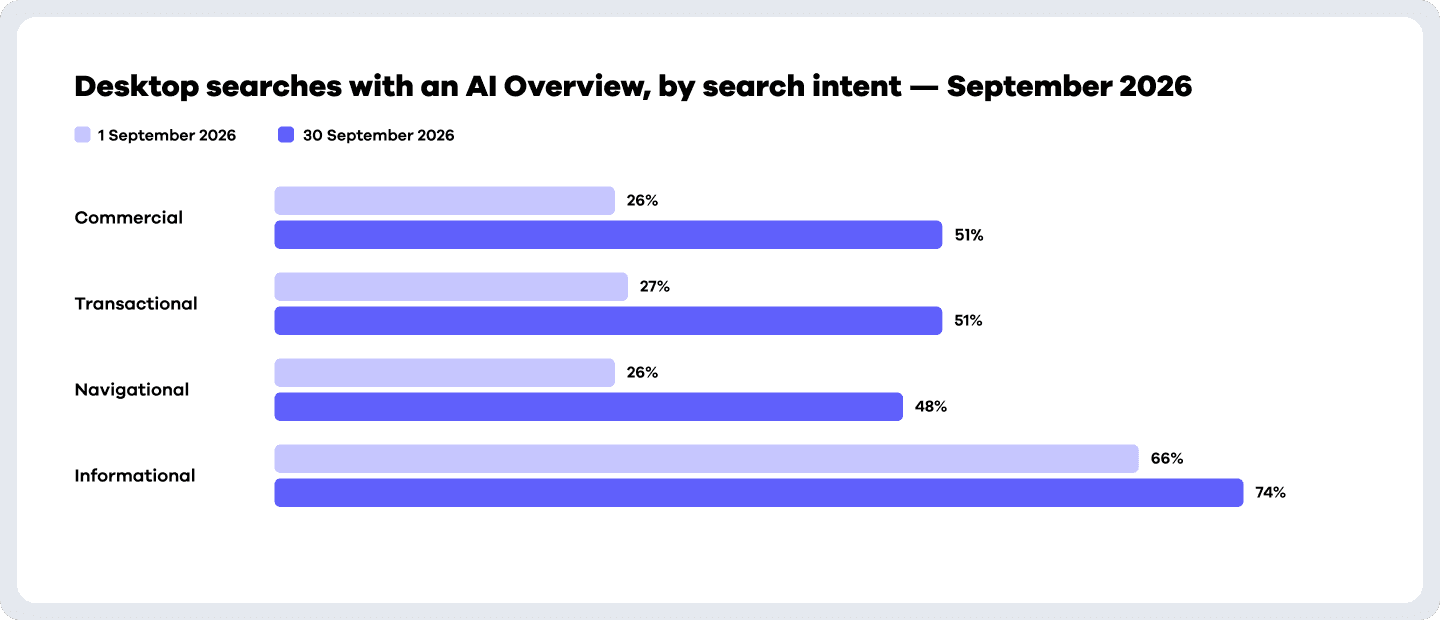 Desktop searches where a tracked domain ranks first, grouped by search intent, on 1 and 30 September 2026.
In just one month, the share of commercial searches showing an AIO almost doubled, jumping from 26% to 51%. Transactional searches followed a similar pattern, increasing from 27% to 51%.
These are not just any keywords. Commercial and transactional searches often come from users who are further along in their buying journey. They might be comparing solutions, researching products, or preparing to make a purchase. In other words, these are precisely the keywords that businesses invest time and resources into ranking for.
How Much Do AI Overviews Affect CTR?
We already know that AIOs can reduce organic clicks. That is hardly breaking news.
What is more interesting is how much they affect CTR. In our July 2026 data, the CTR for the first organic result was 13% on desktop and 13.6% on mobile when an AIO was absent.
When an AIO was present, those numbers dropped considerably. On desktop, the CTR for the first organic result was 5.2%, and on mobile it was 8.3%.
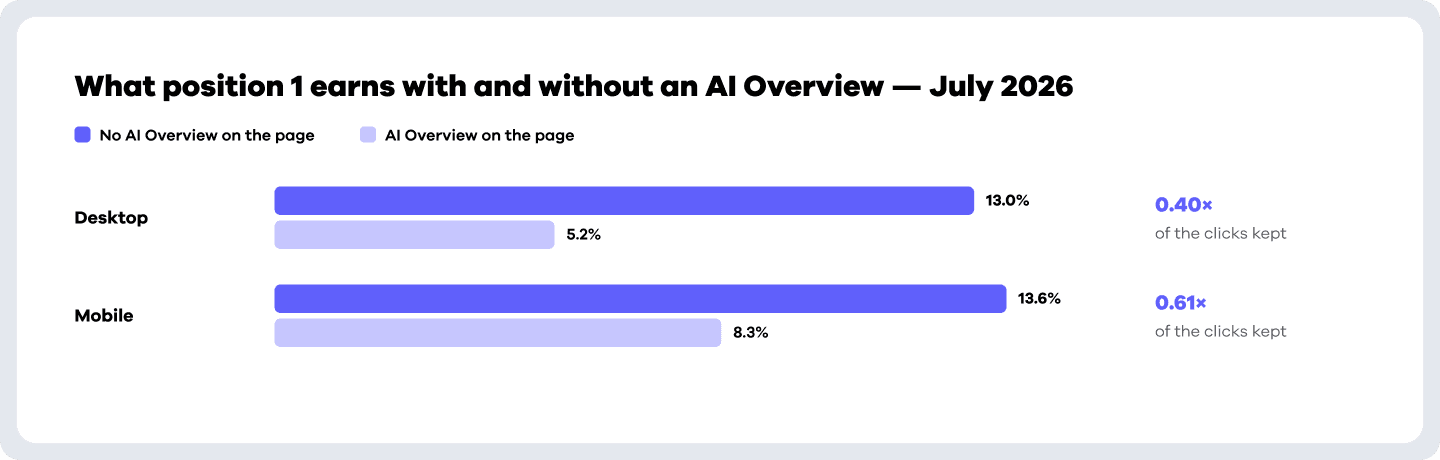
These findings highlight why traditional ranking data cannot explain organic performance on its own. So before you start rewriting every title tag in sight, take a closer look at what Google shows in the search results around your organic ranking.
This is also where we uncovered one of the most interesting findings.
Where AI Overviews Appear Matters More Than You Think
Most discussions about AIOs focus on whether they appear on a SERP. But our data reveal that this is only half the story.
The position of an AIO can make an enormous difference to organic CTR.
Take a look at the CTR for rank-1 organic results, depending on where the AIO appears.
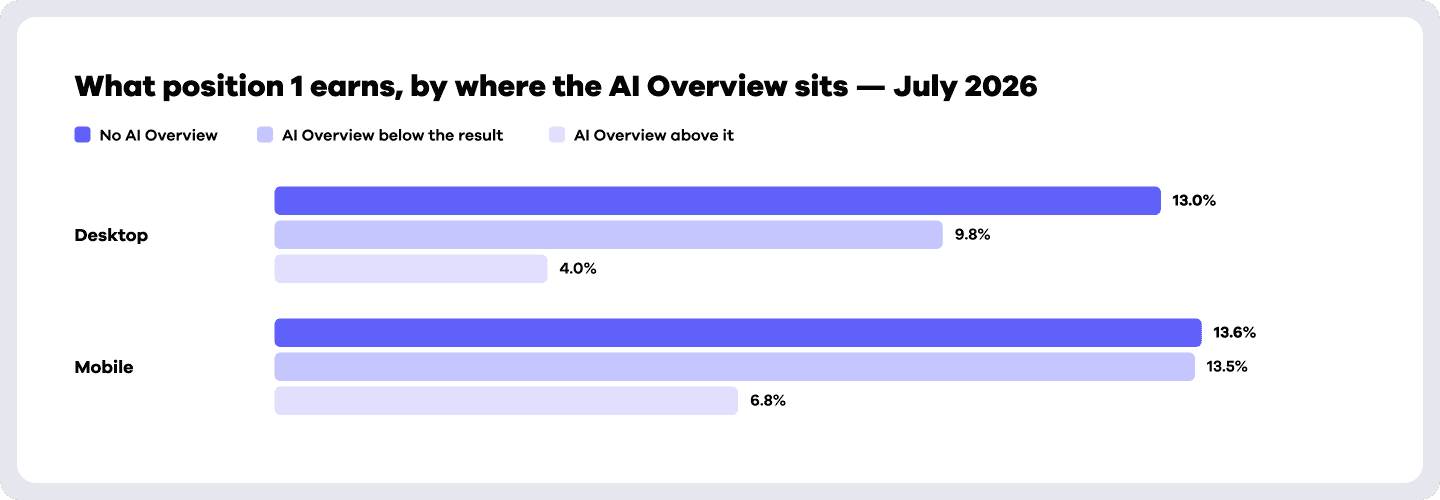 Position 1, July 2026, real Google Search Console CTR.
When an AIO appears above the first organic result, desktop CTR drops from 13.0% to just 4.0%. On mobile, it falls from 13.6% to 6.8%.
But move that same SERP feature below the first organic result, and the impact is considerably smaller. Desktop reaches 9.8%, while mobile CTR remains almost unchanged at 13.5%. That is a rather different picture from the idea that every AIO automatically sends organic clicks into free fall.
AI Overview placement varies by search intent
AIOs are also moving around depending on the search intent. On September 1, 2026, the AIO sat below the position-1 result in 28% of cases. Just one week later, that figure had increased to 37%.
And placement is not random across different search intents. We grouped the same pages using our search intent model. For transactional searches, more than one-third of AIOs appeared as the fourth SERP element or lower. For informational searches, that happened in only about one in eight cases.
In other words, informational queries are more likely to show AIOs at the top of the SERP, while transactional searches more frequently position them further down the page.
This is an important distinction. Just because AIOs are appearing on more commercial and transactional searches does not mean organic clicks are automatically taking a hit. Their placement matters just as much as their presence.
Why does placement make such a difference?
Think about what users actually see when they search on Google. An AIO at the top of the page occupies considerable screen space, especially on mobile devices. But when the AIO appears below the first organic result, the top ranking has the opportunity to capture attention before the AIO even enters the picture.
This helps explain why two keywords with identical rankings and AIO presence can generate very different amounts of traffic.
So simply tracking whether an AIO appears is not enough to understand its potential impact. You also need to know where it appears relative to your organic result. Because AIO presence tells you that Google has invited AI to the party. But AIO placement tells you whether AI gets to speak before you do.
Why You Need Pixel Tracking to Determine Your Visibility
The SERP decides who gets seenRead the blog post
What To Do From Here
AIOs are spreading like wildfire across Google. With their placement and presence constantly changing, your organic visibility could already be shifting beneath your feet. Here are four actions you can take now:
- Track AIO presence and placement: Knowing which keywords trigger AIOs is valuable, but understanding where they appear relative to your organic result provides a more complete picture of their potential impact.
- Monitor commercial and transactional keywords: AIOs are no longer limited to informational searches. Make sure to keep an eye on keywords that contribute directly to leads, sales, and revenue, and monitor how their SERPs evolve.
- Analyze desktop and mobile separately: Our data show significant differences in CTR by device. Combining both into a single average can hide important differences in performance.
- Investigate SERP changes when CTR declines: Stable rankings and declining clicks do not necessarily indicate poor SEO performance. Examine AIO placement and other SERP elements before making changes.
These actions share one common principle: make decisions based on what users actually encounter on the SERP, rather than what a ranking number suggests they should see.
There Is More to the SERP Than Meets the Eye
AIOs are moving in, moving around, and changing how users interact with search results. Our data makes one thing clear: knowing what surrounds your ranking is just as important as where you rank.
Related blog posts

AI Overviews Are Taking Over SERPs
From traffic drops to decreasing CTRs, AI Overviews are shaking up SEO. Learn what is happening and how AccuRanker helps you track AIO.
25 June 2025
Why Your CTR Model Is Betraying You
A static CTR model relies on fixed averages. AccuRanker's dynamic CTR model accounts for 120+ factors to calculate a keyword's expected CTR.
2 June 2026
Meet the Next Generation of Our CTR Model
Meet our rebuilt dynamic CTR model, delivering more accurate CTR estimates based on deeper SERP insights and current click behavior.
22 October 2026