


Meet the Next Generation of Our CTR Model

Sille Christensen
October 22, 2026
Meet our rebuilt dynamic CTR model, delivering more accurate CTR estimates based on deeper SERP insights and current click behavior.
Ranking number one feels pretty straightforward. You made it to the top, so you should get the biggest share of the clicks.
If only SERPs were that simple.
Today, that rank 1 might sit at the top of the page. Or it might have ads, an AI Overview, and several hundred pixels of Google real estate sitting above it. The rank is the same, but the opportunity to win a click can vary widely.
And the SERPs just keep on changing. That is why we have rebuilt our dynamic CTR model. It now has a much deeper understanding of the elements surrounding your organic rankings and learns from current click behavior. The result is a more accurate estimate of the clicks your rankings can actually generate on the SERPs.
Google Is Not Making the SERP Any Simpler
The days of ten blue links are well behind us. Ads, featured snippets, local packs, and plenty of other SERP features have been competing for attention for years. AI Overviews have been taking up their fair share of SERP real estate for a while, too, but they are still spreading fast.
On September 30, 2026, AI Overviews appeared on 66% of the desktop SERPs and 59% of the mobile SERPs we tracked. In July, those figures were 48% and 38%.
And things are not slowing down. In September alone, the share of commercial and transactional desktop searches with an AI Overview nearly doubled.
That matters because every addition to the SERP changes what stands between a search and a click.
But what about the clicks?
Now, you might be thinking, “Yeah, yeah, I know AI Overviews are all over the place right now.” But do you know how they affect rank-1 CTRs? If not, let us tell you.
In July 2026, a rank-1 result on desktop earned 13% CTR on SERPs without an AI Overview, compared with just 5.2% on a SERP with one. On mobile, those numbers were 13.6% and 8.3%. So much for the perks of being number one.
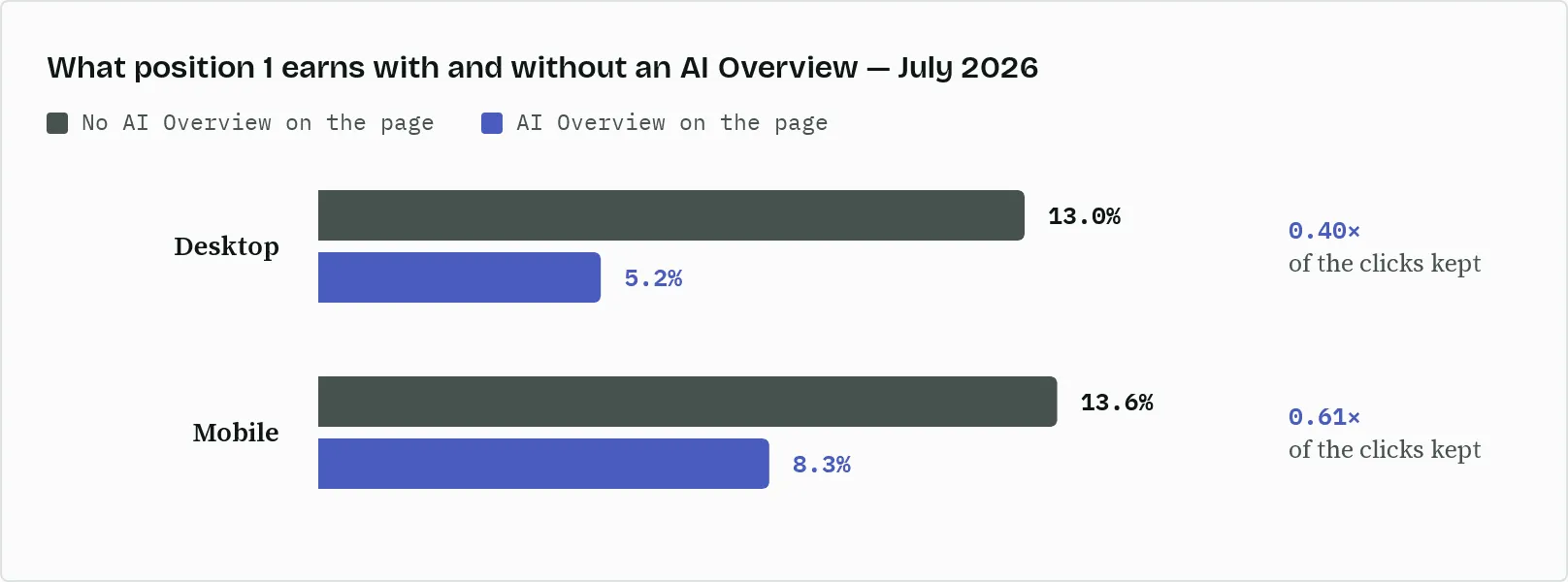
And that is just one SERP feature. Now imagine all the other elements competing for attention on the SERP. We wanted to capture those details more accurately. So we rebuilt our dynamic CTR model to do exactly that.
Dynamic CTR Now Has a Much Better View of The SERP
Our dynamic CTR model has always gone beyond rankings alone. Instead of assuming every rank has a fixed CTR, it uses information about the SERP to estimate the clicks a result can generate.
With this rebuild, we have taken that approach much further.
The updated model understands the SERP in much greater detail, including where results appear and what surrounds them. It accounts for AI Overviews, ads, featured snippets, sitelinks, and other SERP features, including their placement relative to your result.
In total, the model considers 104 signals for each tracked result.
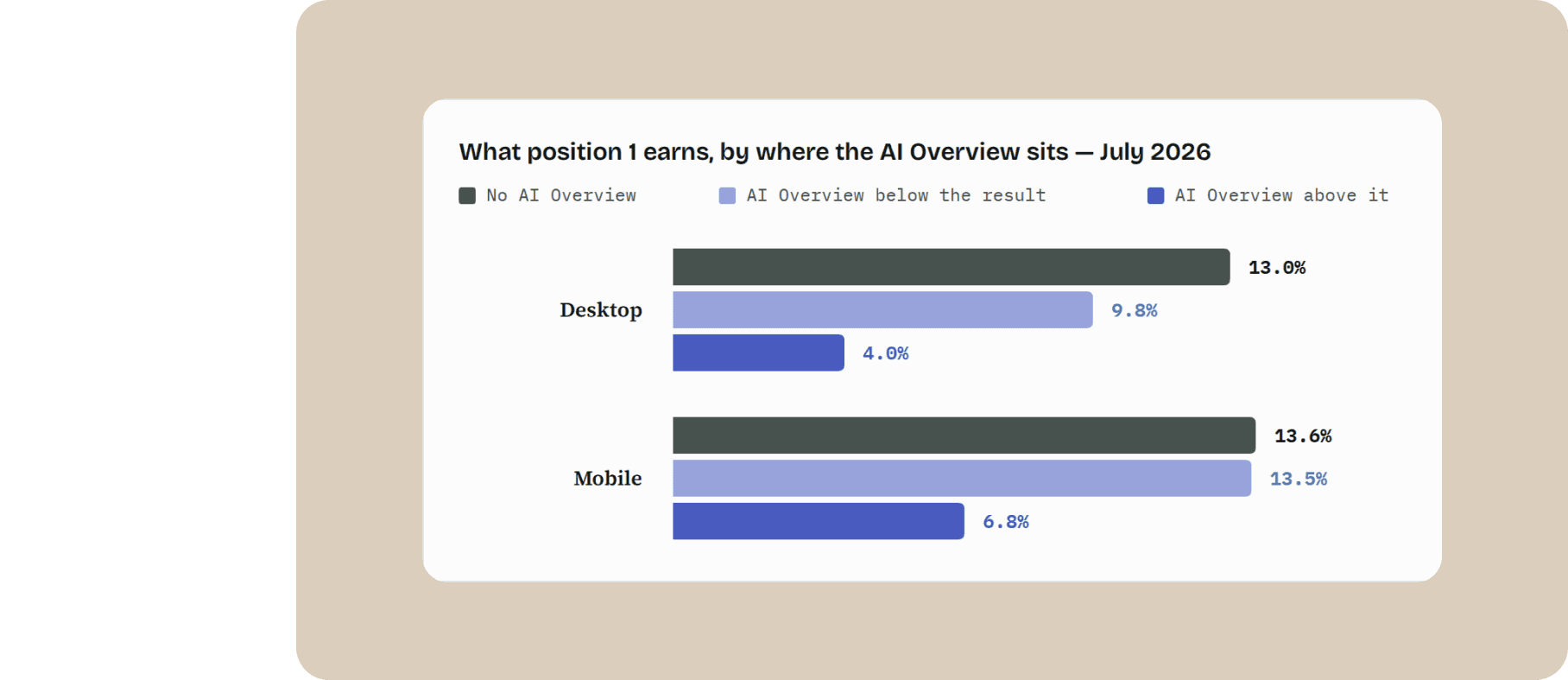
What matters for you is that the CTR model can distinguish between SERPs that might look identical in a traditional rank report but offer very different opportunities to earn a click.
Because rank 1 with nothing above it is not the same as rank 1 sitting below a giant AI Overview. Sure, they are both number one, but that does not mean they have the same chance of winning a click. A good CTR model needs to understand that difference. And ours does.
For anyone who enjoys getting into the weeds, we have plenty more for you to dig into. Our technical deep dive covers the data, methodology, testing, and signals behind the rebuild.
What The Update Means for You
The biggest benefit of this rebuild is simple: you get a better understanding of what your rankings are actually worth.
But there is something you should know. For many tracked keywords in AccuRanker, the estimated CTR will be lower than before. Metrics that use dynamic CTR, such as Share of Voice or Traffic Value, may therefore decrease as well.
That might sound like bad news. It is not. Because lower does not mean worse.
The new model has a much better understanding of the SERP around your ranking and how people interact with it today. So when it gives rank 1 a lower CTR because an AI Overview is taking up most of the space above it, that lower number is more useful. It gives you a more realistic picture of the traffic opportunity behind that ranking.
Despite potential drops, your rankings have not changed. Your real traffic has not changed. And your competitive position has not suddenly fallen. What has changed is the quality of the CTR estimate.
The estimate now gives you an even better foundation for deciding where the biggest opportunities are, understanding why rankings and traffic sometimes move in different directions, and reporting organic performance with more context.
Because a bigger number is not necessarily a better number. But a more accurate one is, and we would rather give you that.
Still Using Static CTR?
We get it. Static CTR is simple and familiar, and it gives you a consistent benchmark based on rank. If it works for your reporting, why change it?
Because a consistent estimate is not necessarily an accurate one.
Static CTR assumes that every result in the same position has the same click potential, regardless of what else appears on the SERP. And as we have seen, that can be a pretty wrong assumption.
Dynamic CTR accounts for those differences. Will the numbers look different? Probably. But if those numbers better reflect the clicks your rankings can generate, is that not exactly what you want from a CTR model?
Static CTR gives you consistency. Dynamic CTR gives you context. And with our upgraded model, there has never been a better time to make the switch.
There Is No Standing Still in Search
SEO is increasingly about understanding the difference between ranking and visibility. Because rank alone cannot tell you how much attention your result receives or how likely someone is to click it. As SERPs become more crowded, that distinction becomes increasingly important.
You need to know not only where you rank, but what that ranking could actually deliver. And that is what our rebuilt dynamic CTR model is designed to show you.
Because Google will probably not stop changing the SERP anytime soon. And neither will the way we measure it.
Related blog posts
A New Dynamic CTR Model Built for Today’s SERPs
Learn why we rebuilt our Dynamic CTR model and how it delivers more accurate CTR estimates based on real click behavior and today’s SERPs.
7 October 2026
Why Your CTR Model Is Betraying You
A static CTR model relies on fixed averages. AccuRanker's dynamic CTR model accounts for 120+ factors to calculate a keyword's expected CTR.
2 June 2026
How AccuRanker’s AI Models Fix Inaccurate SEO Data
Struggling with unreliable SEO data? Discover how AccuRanker’s CTR, Search Intent, Search Volume, and Share of Voice deliver accurate insights.
1 June 2025