


Why You Need Both LLM and Rank Tracking

Sille Christensen
March 12, 2026
Learn why SEOs need both rank tracking and LLM tracking to measure and understand their visibility across SERPs and AI answers.
Your rankings look great, but your traffic is still dropping. Welcome to SEO in 2026.
SEO is no longer just about ten blue links. It is about visibility across SERPs and LLM interfaces. Ranking well in search engines is still crucial, but is no longer the only signal of success. Your brand also needs to appear in AI answers that shape how users discover, evaluate, and decide.
To understand how visible you really are, you need insight into both worlds. Let us break down how rank tracking and LLM tracking play a critical role individually and how they complement each other.
Why You Need Rank Tracking
Despite the rise of generative AI in search, rankings still matter. They influence traffic, brand visibility, and revenue. However, in 2026, rank tracking must go far beyond just checking whether you moved from position 7 to position 3 on the SERP.
Because SERPs are dynamic. AI Overviews, featured snippets, ads, and other SERP features reshape the SERP layout and dramatically change click behavior. A number one ranking does not guarantee traffic. In fact, the CTR for rank 1 can vary from 0% to 75% depending on the SERP layout. Therefore, if you only track rankings, you miss the factors that explain your performance.
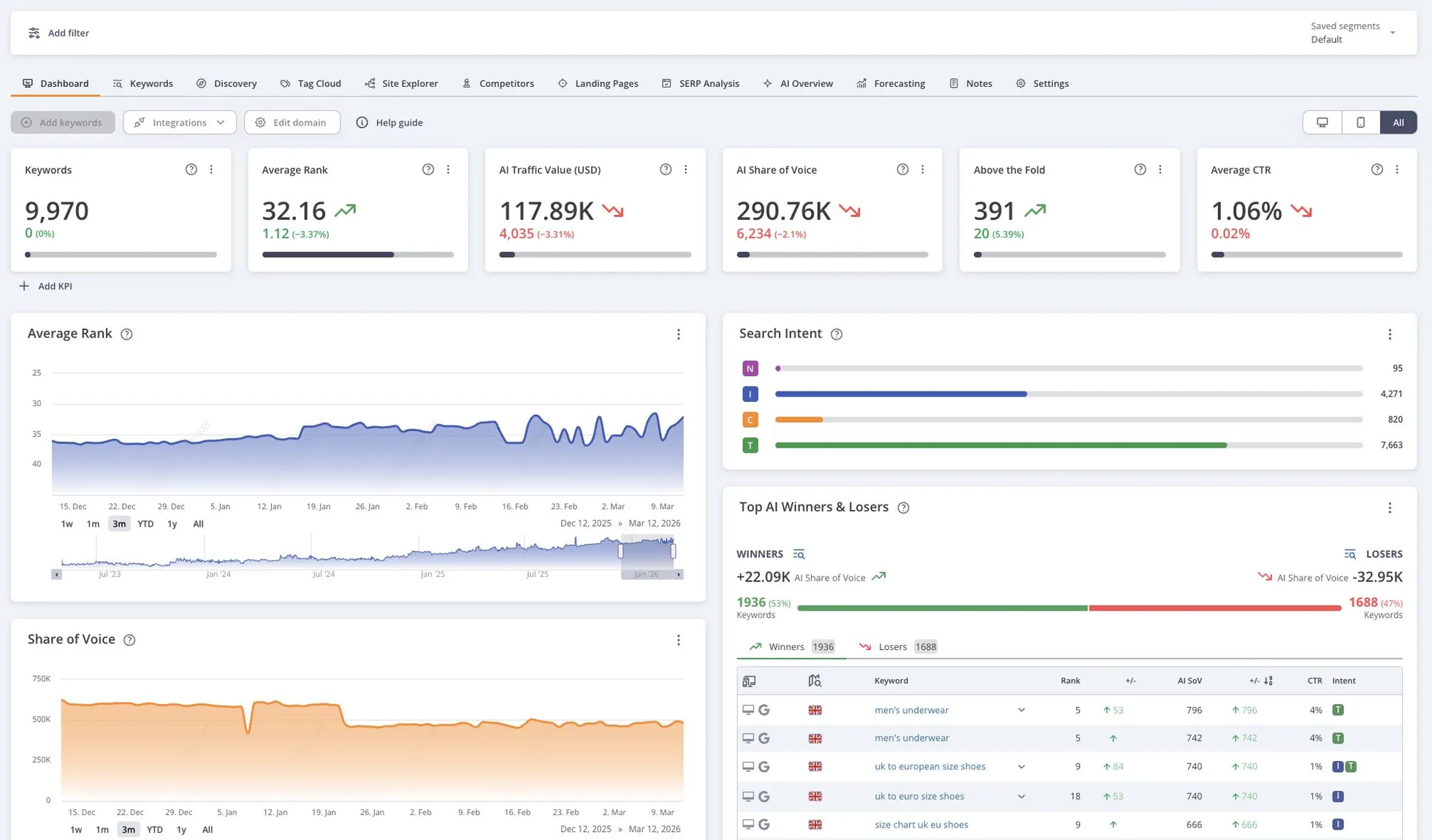
A good rank tracker should deliver real-time, accurate keyword data with SERP context, so you can understand not just where you rank but what that ranking means for your traffic potential. With AccuRanker, you can:
- Monitor real-time keyword rankings across devices and locations
- Analyze SERP features and how they impact visibility
- Measure Share of Voice and benchmark against competitors.
When you combine rankings with SERP insights, you can see where the opportunities are, where competition is intensifying, and where your optimizations will have the greatest impact.
Why You Need LLM Tracking
LLM tracking measures how your brand appears in AI-generated answers across LLMs like ChatGPT, Perplexity, and Gemini. Though traditional search still dominates, LLM usage is growing rapidly. As of late February 2026, OpenAI’s ChatGPT has more than 900 million weekly active users, emphasizing LLMs as a new channel for brand visibility you cannot ignore.
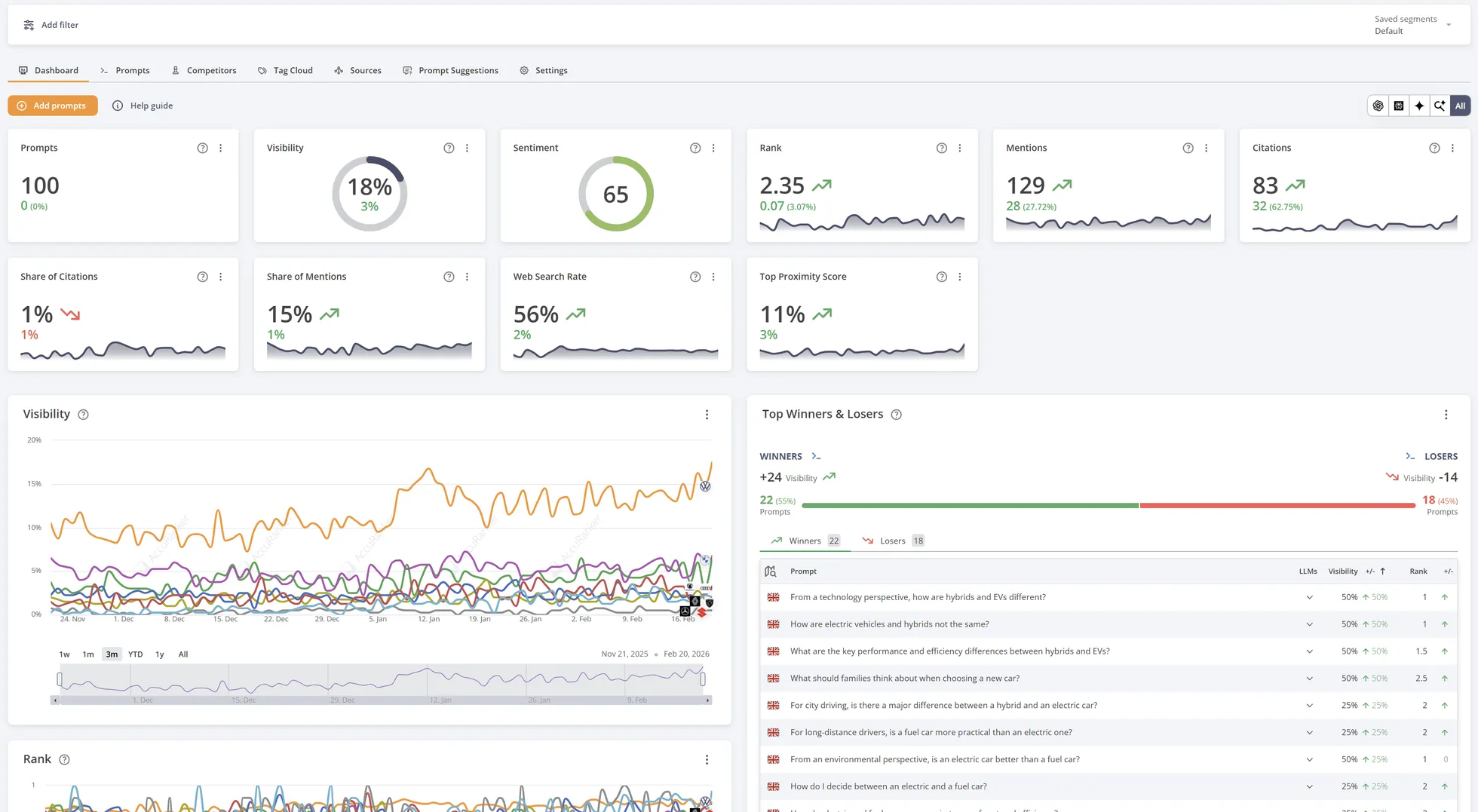
A good LLM tracker should monitor how, where, and in what context your brand appears in AI answers so you can measure your LLM presence and influence. With AccuLLM, you can:
- Track how your AI visibility changes over time
- Analyze the sentiment when the LLMs mention your brand
- Learn which sources the LLMs cite most often.
LLM tracking extends the traditional idea of SEO by tracking visibility that does not show up in your classic ranking reports. If LLMs increasingly shape user decisions before users visit a website, you must measure that layer of visibility to know whether you are present in the right place at the right time.
How Rank Tracking and LLM Tracking Go Hand in Hand
Rank tracking and LLM tracking do not measure the same thing. One tracks keywords, the other tracks prompts. Rank tracking answers the question: Where do we rank? LLM tracking answers the question: Are we part of the answer? That is two distinct layers of visibility. And that is precisely why you need both.
Together, they give you a comprehensive view of your SEO visibility.
Imagine this: Your rankings remain stable, but traffic declines. Here, rank tracking alone may not explain the drop. An LLM tracker, however, can reveal whether AI-generated answers are absorbing attention. Conversely, LLM tracking can measure your visibility beyond rankings, showing when and how your brand appears in AI answers even without a top spot on the SERP.
We did not make this scenario up — we actually see it happening in practice. One of our clients, Eagle Eyed Digital, saw this exact situation unfold. To solve it, the agency integrated rank tracking and LLM tracking, giving the specialists a new way to explain visibility to their clients:
"We no longer just say, ‘You are ranking well.’ We can now show where and how their brand is being surfaced in both search engines and AI systems, with a clear view of their brand’s sentiment rather than just appearing in the responses."
This is exactly what combining rank tracking and LLM tracking is all about. Instead of guessing, you can now point to data that tells you exactly how you perform in SERPs and LLMs. And that changes how SEO performance is understood, measured, and reported.

Looker Studio for AccuRanker and AccuLLM
Collecting all this SEO data is one thing. Communicating it is another. Agencies need to show clients how they perform in both traditional and AI search. Executives need dashboards that connect SEO metrics to business outcomes. And SEO teams need all insights in one place for easy access and a quick overview.
This is where our Looker Studio integration brings everything together.
The integration makes it easy to visualize your SEO performance, report on results, and share insights with stakeholders. You can start with our pre-made template or copy and customize it to fit your reporting needs.
With Looker Studio for both AccuRanker and AccuLLM, you can build a dashboard that combines rank tracking and LLM data, transforming scattered insights into a clear view of your search performance and making reporting easier.
Know Your Real Search Performance
Search no longer happens in just one place. It happens in search engines. It happens in LLMs. And increasingly, it happens in both at the same time. If you only track rankings, you miss how LLMs mention your brand. If you only track LLM mentions, you lose sight of the traffic opportunities driven by search engines. The real insight comes from combining both.
In 2026, the most successful SEO strategies will not focus on a single search platform. They will track and optimize visibility wherever search happens. Talk to our experts to learn how you can track your performance in traditional and AI search.
Related blog posts

Track Your LLM Performance with AccuLLM
You can now track ChatGPT, Perplexity, AI Overview, and AI Mode with AccuLLM. Learn how we help you monitor your LLM performance.
20 October 2025
5 LLM Visibility Metrics You Should Track in 2026
SEO is now both about ranking in search engines and being visible in LLMs. We give you five visibility metrics every SEO should track in 2026.
3 December 2025
How LLMs Change Traditional SEO Metrics
Learn why rankings, CTRs, and impressions fail to measure visibility in AI-powered search — and what SEOs should track instead.
15 July 2025