

Share of Voice
OverviewLearn how Share of Voice is calculated and how to configure the calculation
Share of Voice shows how visible your domain is in the organic search results. AccuRanker calculates it using your rankings, the click-through rate (CTR) of each ranking, and the search volume of each keyword.
You can choose the CTR model and search volume source used in the calculation. These settings also apply to Share of Voice % and Traffic Value.
For background on why Share of Voice is now one configurable metric, see Share of Voice update.
How Is Share of Voice Calculated?
For an individual keyword, Share of Voice is calculated as:
Share of Voice = CTR × search volume
The CTR is the estimated percentage of searchers who click your result. The search volume is the number of searches for the keyword in one month.
For example, suppose a keyword has a monthly search volume of 10,000. Your page is ranked #1, and the CTR for that result is 30%. The Share of Voice for the keyword is 3,000.
AccuRanker adds up the Share of Voice of all keywords in your current view. You can analyze Share of Voice for a domain, group, tag, landing page, or filtered list of keywords. Keywords with higher search volumes have a greater effect on the total.
Only results in the top 20 organic positions receive a CTR. If a keyword ranks below position 20 or does not rank, its Share of Voice is 0.
Share of Voice is an estimate and does not represent the actual number of clicks to your website. Use Google Search Console when you need actual click data.
How the CTR Model and Search Volume Source Affect Share of Voice
Two settings control the Share of Voice calculation:
| Setting | Options |
|---|---|
| CTR model | Dynamic CTR or Static CTR |
| Search volume source | AccuRanker Search Volume or Google Keyword Planner. Google Keyword Planner can be local or national search volume. |
The same settings apply to Share of Voice, Share of Voice %, and Traffic Value.
We recommend Dynamic CTR with AR Search Volume. New accounts use this calculation by default.
Dynamic CTR
Dynamic CTR is AccuRanker's machine-learning model for estimating CTR. Instead of using only your rank, it considers the complete search results page. Because two pages at the same rank can have different CTR values when their SERPs are different.
The model uses signals such as:
- How far down the page your result starts.
- Which SERP features appear above your result, such as an AI Overview.
- How many ads appear above the organic results.
- Whether an AI Overview cites your domain.
There is one Dynamic CTR model for desktop and another for mobile. We train the models using tracked results matched with Google Search Console data.
Static CTR
Static CTR assigns a fixed CTR to each rank. All keywords at the same rank receive the same CTR. For example, rank 1 receives approximately 31%, rank 2 approximately 13%, and rank 20 less than 1%.
Use Static CTR to stay comparable with Share of Voice from before the update; Share of Voice % is a new metric, and the closest match to the old 'Show share of voice as percentage' is the CTR chart with Static CTR.
AR Search Volume
AR Search Volume is AccuRanker's estimate of monthly search volume. It provides separate values for desktop and mobile searches. We recommend connecting to Google Search Console to make your estimates more accurate. AR Search Volume works without this connection as well.
In the Keywords list, this appears as the AR SV column.
For more information, see AR Search Volume.
Google Keyword Planner Search Volume
Google Keyword Planner search volume comes from Google Ads. In the Keywords list, it appears as the Search Volume column.
For keywords with a location, such as a city, you can choose between local and national search volume. Local search volume uses the keyword location, while national search volume uses the country.
Keywords on other search engines
Dynamic CTR and AR Search Volume are available only for Google keywords.
Keywords tracked on other search engines, including Bing, Baidu, Naver, and YouTube, always use Static CTR and the standard search volume for the keyword. Changing your Share of Voice settings does not change how these keywords are calculated. Note that these keywords still contribute to your total Share of Voice.
How to Choose Your Account Share of Voice Settings
Account-level settings apply to all domains that use them. Only organization admins can change them.
- Go to Account in the sidebar.
- Select Account Settings.
- Find Account Display Settings.
- Toggle the Dynamic CTR switch to on for Dynamic CTR or off for Static CTR.
- Toggle the AR Search Volume switch to on to use AR Search Volume or off to use Google Keyword Planner.
- If AR Search Volume is off, set Local search volume to on for local search volume or off for national search volume.
- Click Save.
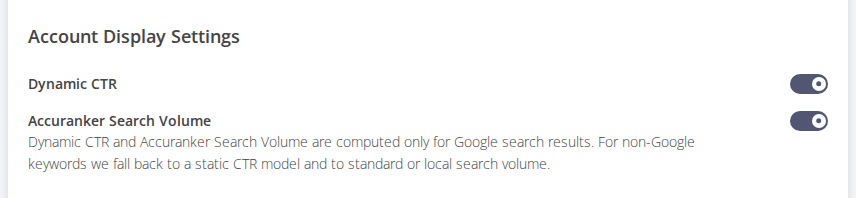 The recommended settings: Dynamic CTR and AR Search Volume.
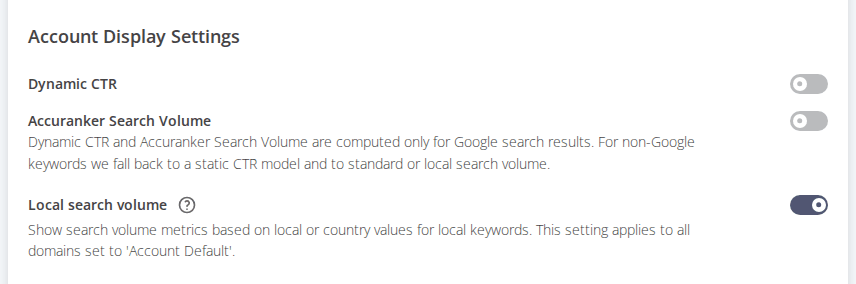 Static CTR with Google Keyword Planner search volume. The local search volume switch shows when AR Search Volume is off.
After you save your settings, AccuRanker calculates Share of Voice using the selected configuration each time you open a page. Your charts use the selected settings across all dates.
When you use Dynamic CTR, the CTR for each historical date comes from the CTR model AccuRanker used on that date. AccuRanker does not change these historical CTR values.
How to Use Different Share of Voice Settings for One Domain
By default, a domain uses your account-level display settings. Users with write access to a domain can override these settings for an individual domain.
- Open the domain.
- Go to the Settings tab.
- Select Data Display settings.
- Turn off Use account display settings.
- Configure the Dynamic CTR setting.
- Configure the AR Search Volume setting.
- If AR Search Volume is off, configure Local search volume.
- Click Save.
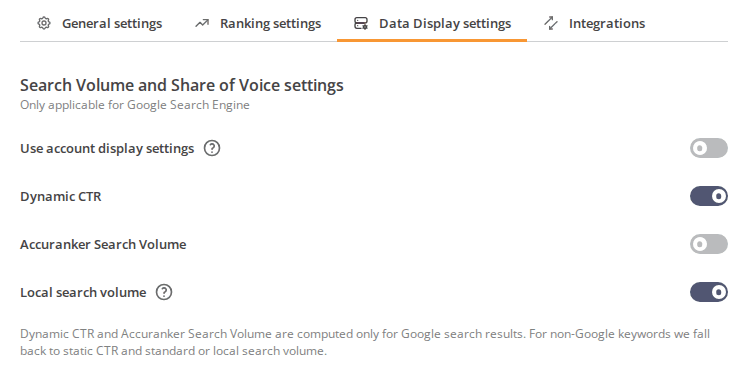 This domain uses Dynamic CTR with local Google Keyword Planner search volume. The account settings do not apply to it.
To restore the domain to your account-level settings, enable Use account display settings, then click Save.
When comparing domains in a group view, use the same settings across the domains so they use the same Share of Voice calculation.
What Is Share of Voice %?
Share of Voice % shows how much of the maximum possible Share of Voice you have, on a scale from 0 to 100%.
Share of Voice % = your Share of Voice ÷ maximum Share of Voice × 100
The maximum Share of Voice for a keyword is the Share of Voice you would receive at the best organic position available on that SERP. This is usually rank 1.
For multiple keywords, AccuRanker adds up your Share of Voice across the keywords and their maximum Share of Voice. It then divides the first sum by the second sum. Keywords with higher search volumes have a greater effect on the percentage than keywords with lower search volumes.
Here is an example:
| Keyword | Your Share of Voice | Maximum Share of Voice |
|---|---|---|
| Keyword A | 1,500 | 3,000 |
| Keyword B | 300 | 300 |
| Total | 1,800 | 3,300 |
Share of Voice % is: 1,800 ÷ 3,300 × 100 = 55%
Share of Voice % uses the same settings as Share of Voice. It replaces the previous Show share of voice as percentage setting.
You can view Share of Voice % in the keywords list, on the dashboard, in reports, and in the API.
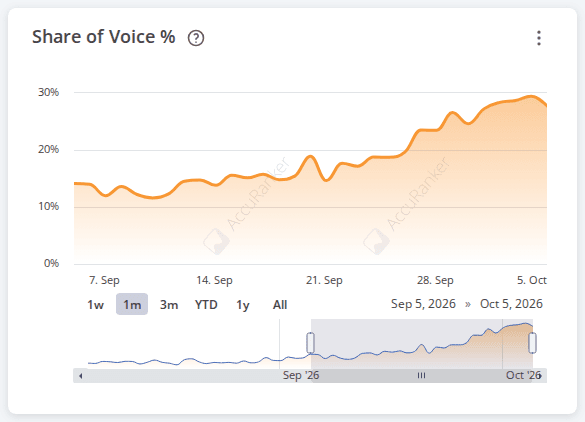 The Share of Voice % chart shows your part of the maximum possible Share of Voice over time.
How Is Traffic Value Calculated?
Traffic Value uses the Share of Voice of a keyword and the average cost per click from Google Ads:
Traffic Value = Share of Voice × average cost per click
Traffic Value uses the same calculation settings as Share of Voice.
AccuRanker displays Traffic Value in your selected CPC currency. You can change this using the CPC Currency setting in Account Display Settings or in the domain's Data Display settings.
How to View Share of Voice in the Keywords List
The Keywords list shows Share of Voice for each keyword.
| Column | What It Shows |
|---|---|
| SoV | The Share of Voice of the keyword. |
| +/- next to SoV | The change in Share of Voice since the compare date. |
| Max next to SoV | The maximum Share of Voice of the keyword. |
| SoV % | The Share of Voice % of the keyword. |
| Traffic Value | The Traffic Value of the keyword in your CPC currency. |
| CTR | The CTR of your result. |
| Search Volume | Google Keyword Planner search volume. |
| AR SV | AR Search Volume. |
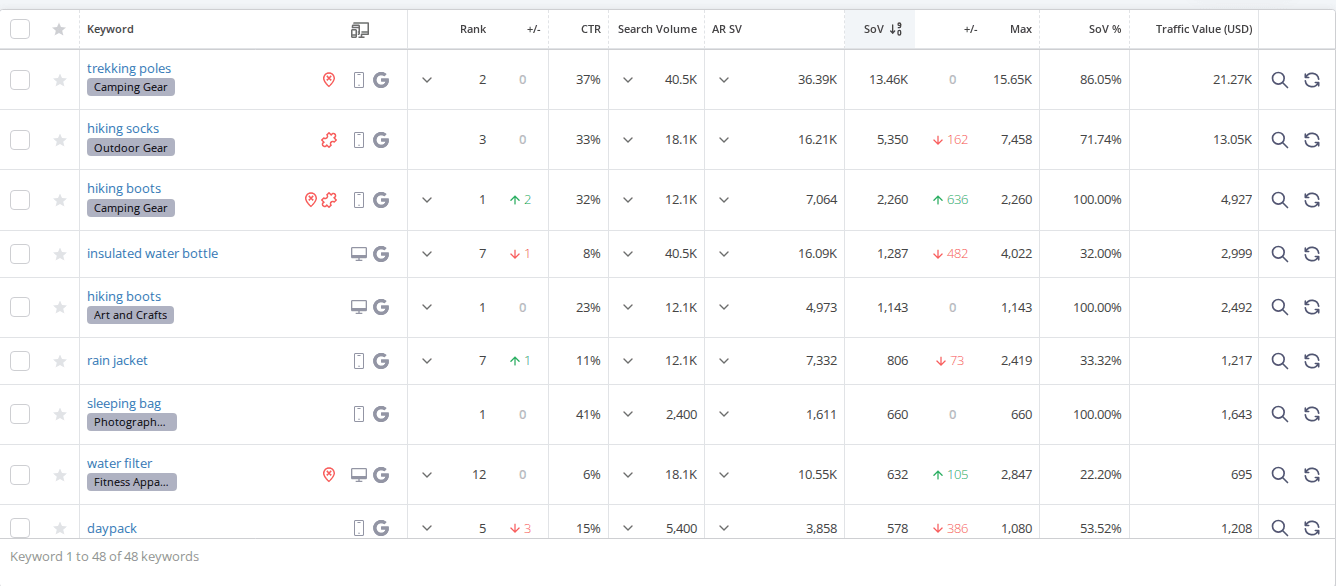 The keyword list sorted by Share of Voice. With AR Search Volume, SoV is the CTR multiplied by AR SV.
When using AR Search Volume, SoV is calculated using CTR and AR SV.
How to configure Share of Voice columns
- Open the domain.
- Go to the Keywords tab.
- Click Configure columns.
- Find the Share of Voice group.
- Select the columns you want to display.
- Click Update.
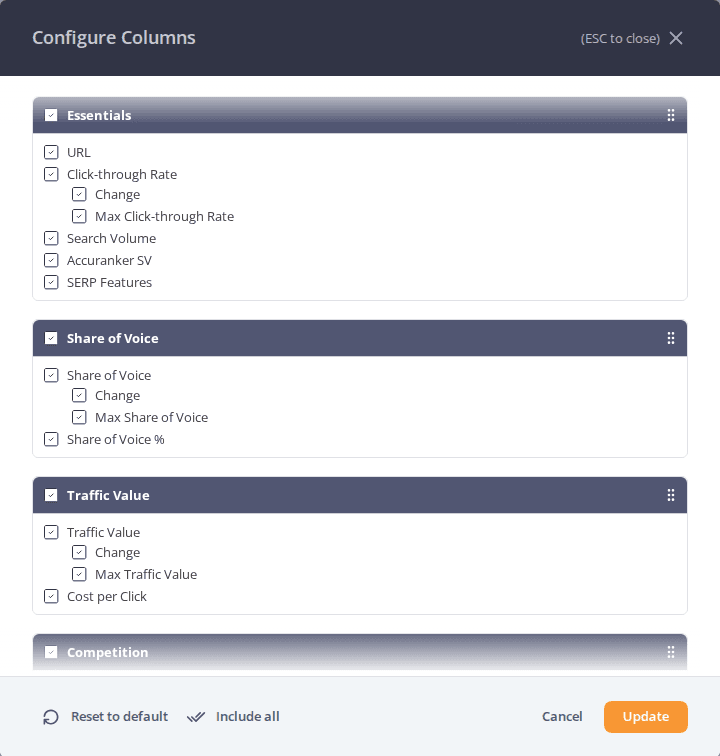 The Share of Voice group includes Share of Voice, Change, Max Share of Voice, and Share of Voice %.
How to sort keywords by Share of Voice
To sort your keywords by Share of Voice, click the SoV column header and select Highest to lowest.
How to View Share of Voice on the Dashboard
The domain dashboard shows Share of Voice in KPI boxes and charts.
Share of Voice KPIs
The KPI boxes show Share of Voice, Share of Voice %, and Traffic Value for the keywords included in your current filter. They also show the change since the comparison date.
Click Add KPI to add a KPI box.
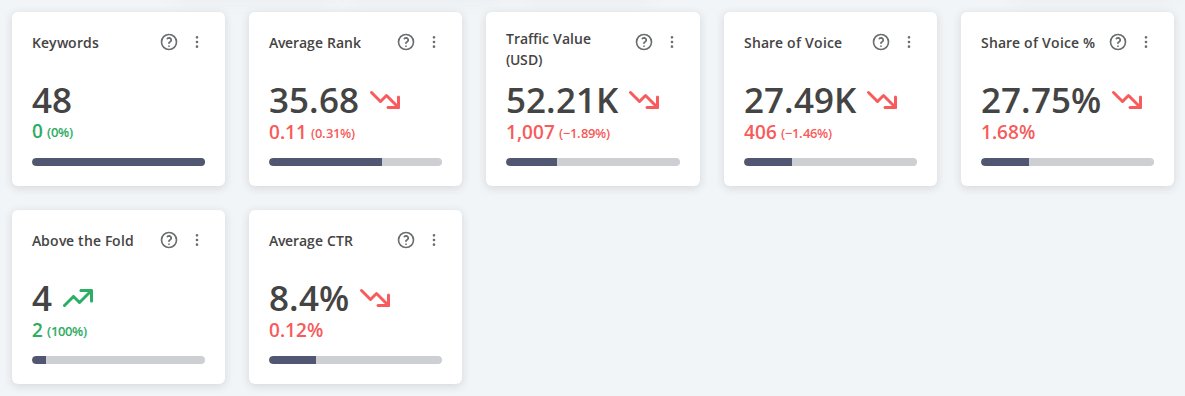 The KPI boxes for Traffic Value, Share of Voice, and Share of Voice %.
Share of Voice Widgets
These widgets show Share of Voice:
- Share of Voice shows your total Share of Voice over time.
- Share of Voice % shows your Share of Voice % over time.
- Share of Voice, by breaks down Share of Voice by tags, competitors, or landing pages. Click the Tags, Competitors, or Page tab.
If you want to add these widgets to your dashboard, click Add Widget, then select the relevant chart from Available Widgets.
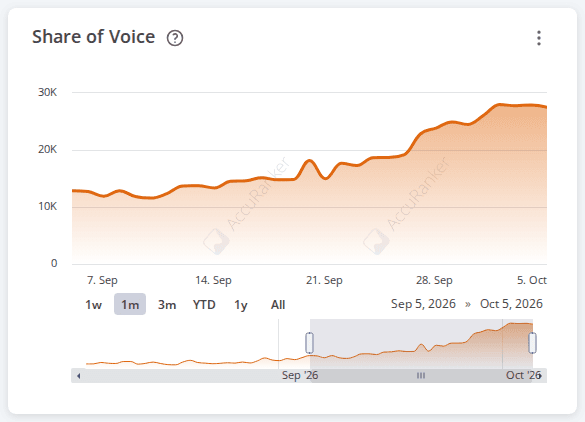 The Share of Voice Chart for the last month.
You can use the desktop and mobile icons in the upper-right corner of the chart to show only desktop or mobile keywords. Select All to include all keywords.
Use 1w, 1m, 3m, YTD, 1y, or All below the chart to change the period. You can also click a point on the Share of Voice chart to see the keywords contributing to the Share of Voice at that point.
How to compare Share of Voice with competitors
Open the Competitors tab in the Share of Voice, by chart to compare your Share of Voice with your competitors.
AccuRanker calculates competitor Share of Voice using the settings configured for your domain.
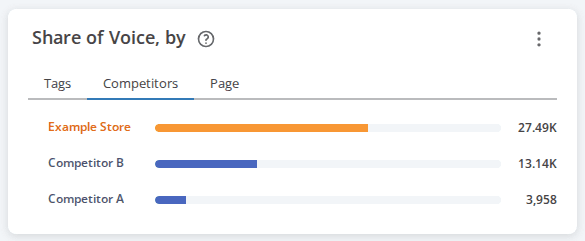 Your Share of Voice and the Share of Voice of two competitors.
The Competitors tab also shows Share of Voice and Share of Voice % for each competitor.
You can also find Share of Voice and Share of Voice % in the Tag Cloud, Landing Pages page, and Domains list.
How to Use Share of Voice in Reports, Exports, and the API
Reports
You can add Share of Voice and Share of Voice % charts to report templates:
- Go to Reporting in the sidebar.
- Select Report Templates.
- Click New template.
- Find the Share of Voice chart card and click Add.
- Find the Share of Voice % chart card and click Add.
- Enable Include competitors for a chart if you want competitor data included.
- Enter a Template Name.
- Click Save template.
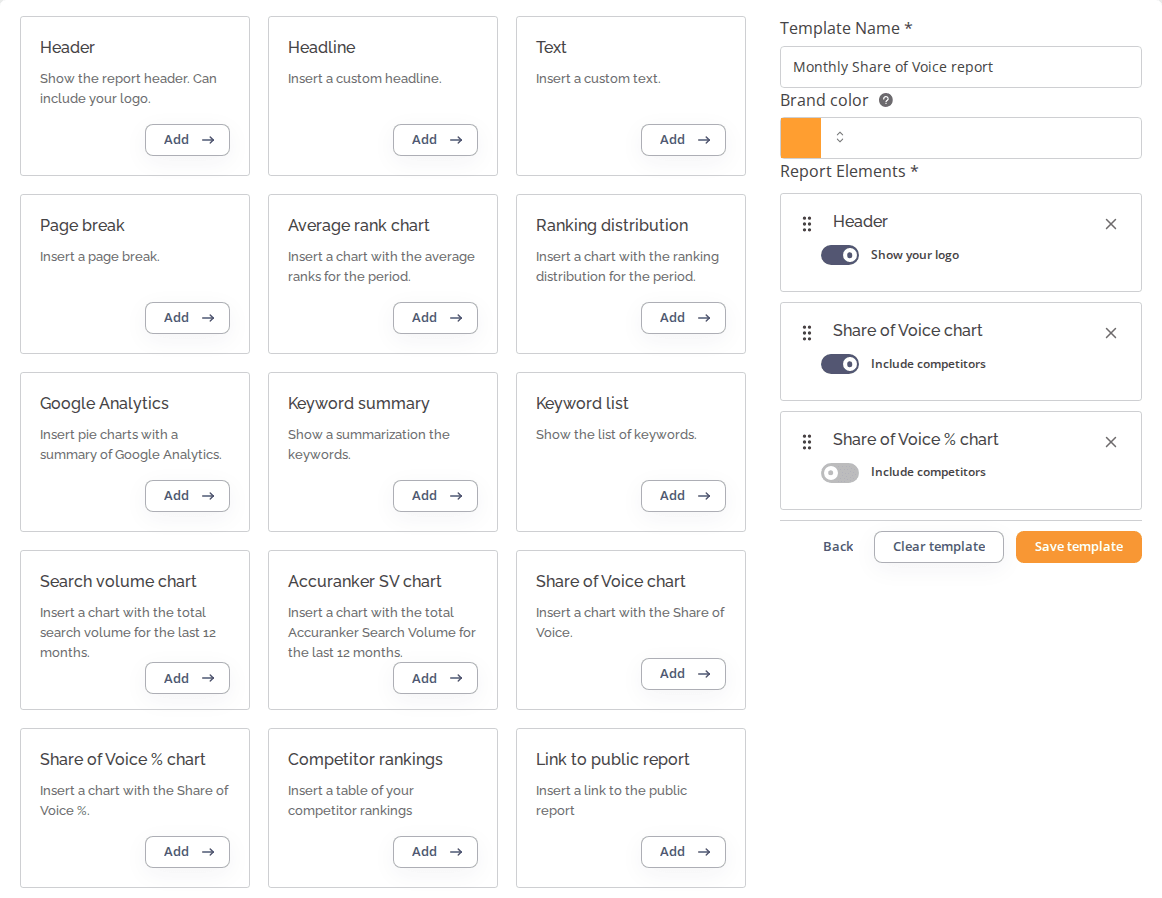 A report template with a Share of Voice Chart that includes competitors and a Share of Voice % chart.
The Period over Period element also includes Share of Voice, Share of Voice %, and Traffic Value.
Exports
When you select Download report from the keyword list, the exported file includes SoV, SoV %, and Traffic Value columns.
API
The API provides Share of Voice through these fields:
share_of_voiceshare_of_voice_percentagetraffic_value
The share_of_voice_percentage field is a fraction from 0 to 1. For example, 0.2775 represents 27.75%.
Earlier AI metric fields, including ai_share_of_voice and ai_traffic_value, remain available in the API. They return the same values as share_of_voice and traffic_value. All of these fields use your selected settings.
How to Exclude Keywords From Share of Voice
You may want to exclude keywords that make your Share of Voice less representative of the visibility you want to measure. Branded keywords are a common example: your domain often ranks first for its own brand, while competitors do not actively compete for that term.
To exclude existing keywords from Share of Voice:
- Open the domain and go to the Keywords tab.
- Select the keywords you want to exclude.
- Click Edit, then Change settings.
- Under Advanced Settings, select Ignore in Share of Voice.
- Click Change settings.
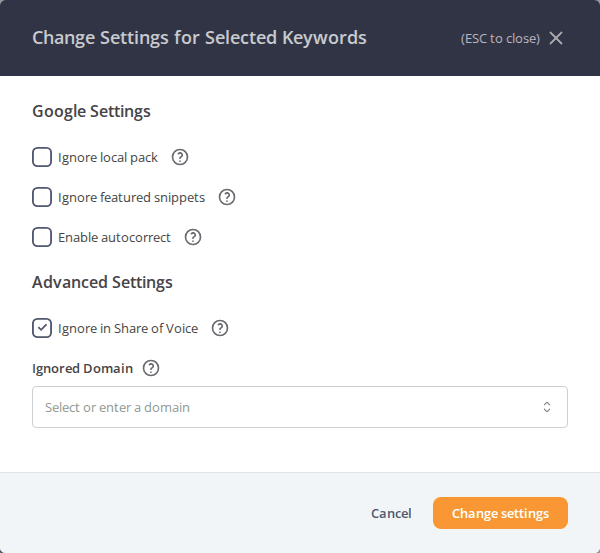 Select Ignore in Share of Voice to exclude the selected keywords.
When adding new keywords, you can select Ignore in Share of Voice under Advanced settings before adding them.
An excluded keyword has a Share of Voice of 0 and does not contribute to Share of Voice % or Traffic Value. AccuRanker applies the current setting across all dates.
To find excluded keywords, add the Keyword Options filter and select Ignore in Share of Voice.
What Changed With Share of Voice?
On October 21, 2026, AccuRanker changed Share of Voice into a single, configurable metric.
Share of Voice and AI Share of Voice are now combined into one metric. To use the AI Share of Voice calculation, select Dynamic CTR.
The update also introduced the following changes:
- AI Share of Voice, AI Traffic Value, and Estimated Visits columns were removed.
- Share of Voice % replaced the Show share of voice as percentage setting.
- Traffic Value uses the same settings as Share of Voice.
- Keywords on other search engines contribute to the total Share of Voice, also when you use Dynamic CTR.
- AccuRanker updated saved columns, segments, report templates, and report filters to use the new metrics.
- Saved links containing a removed filter open without that filter.
- The API fields keep their names.
If you did not select settings before October 21, 2026, your account uses Dynamic CTR and AR Search Volume. You can change these settings at any time.
Still need help?
Customer support
Our live support team is ready to assist you with any issues.