


Still Using Static CTR? Here Is When It Is Time to Switch
Sille Christensen
November 19, 2026
Using static CTR out of habit? Find out when to switch to dynamic CTR, what happens to your numbers, and why the change might be worth it.
Old habits die hard. Especially when they come with familiar numbers and reports that look exactly as you expect.
Static CTR is simple. It is predictable and easy to work with. And if you have been using static CTR for years, you probably have a good reason to stick with it. So why mess with something that works?
Because sometimes, sticking with what you know means missing out on something better.
There is a difference between a CTR estimate that is easy to work with and one that reflects the click opportunities on today’s SERPs. And if you rely on those estimates to make SEO decisions, that difference matters.
With our recently rebuilt model delivering our most accurate CTR estimate yet, now might be a pretty good time to reconsider which approach is right for you.
Static CTR Still Has Its Place
There is a reason static CTR has been a familiar part of SEO for so long.
It is straightforward. Each organic ranking is assigned a CTR, regardless of how the rest of the SERP looks. That makes static CTR useful if you want to compare rankings using the same assumptions, track changes against a familiar benchmark, or keep your reporting consistent.
So if a consistent, rank-based benchmark is what you need from your CTR, it does the job.
But if you use those estimates to decide where to invest your SEO efforts, a consistent benchmark that relies solely on rankings can leave out some pretty important context.
And that is where dynamic CTR starts to earn its keep.
When Does It Make Sense to Switch?
Consider whether you are using CTR as a benchmark or to make decisions. It matters because there is a difference between asking “What CTR would I expect at this ranking position?” and “How many clicks could this ranking realistically deliver?” That difference can be pretty important.
Here are three situations where dynamic CTR is the better choice.
1. When you are deciding which keywords to prioritize
Not every keyword with a promising search volume and an achievable ranking offers the same traffic opportunity.
Imagine you are deciding which of two keywords deserves your attention.
They have similar search volumes, and you currently rank fourth for both. With static CTR, improving either keyword to rank 2 would produce a similar estimated increase in clicks.
But what if one SERP has very few competing features, while ads and an AI Overview dominate the other? Suddenly, those opportunities look quite different.
Our dynamic CTR helps you see that difference. It accounts for the SERP conditions for each ranking, giving you a more realistic basis for evaluating potential clicks.
And when you are managing hundreds or thousands of keywords, being able to identify the opportunities with the greatest potential makes a real difference to how you spend your time and resources. Because improving ranks is great. But improving ranks that can actually deliver meaningful traffic is even better.
2. When you want more realistic expectations for organic traffic
We all like a promising traffic estimate. But an estimate is only useful if it reflects the opportunity you are actually pursuing.
Static CTR provides a straightforward calculation based on rank. The problem is that Google does not give every result in the same position an equal chance of earning a click.
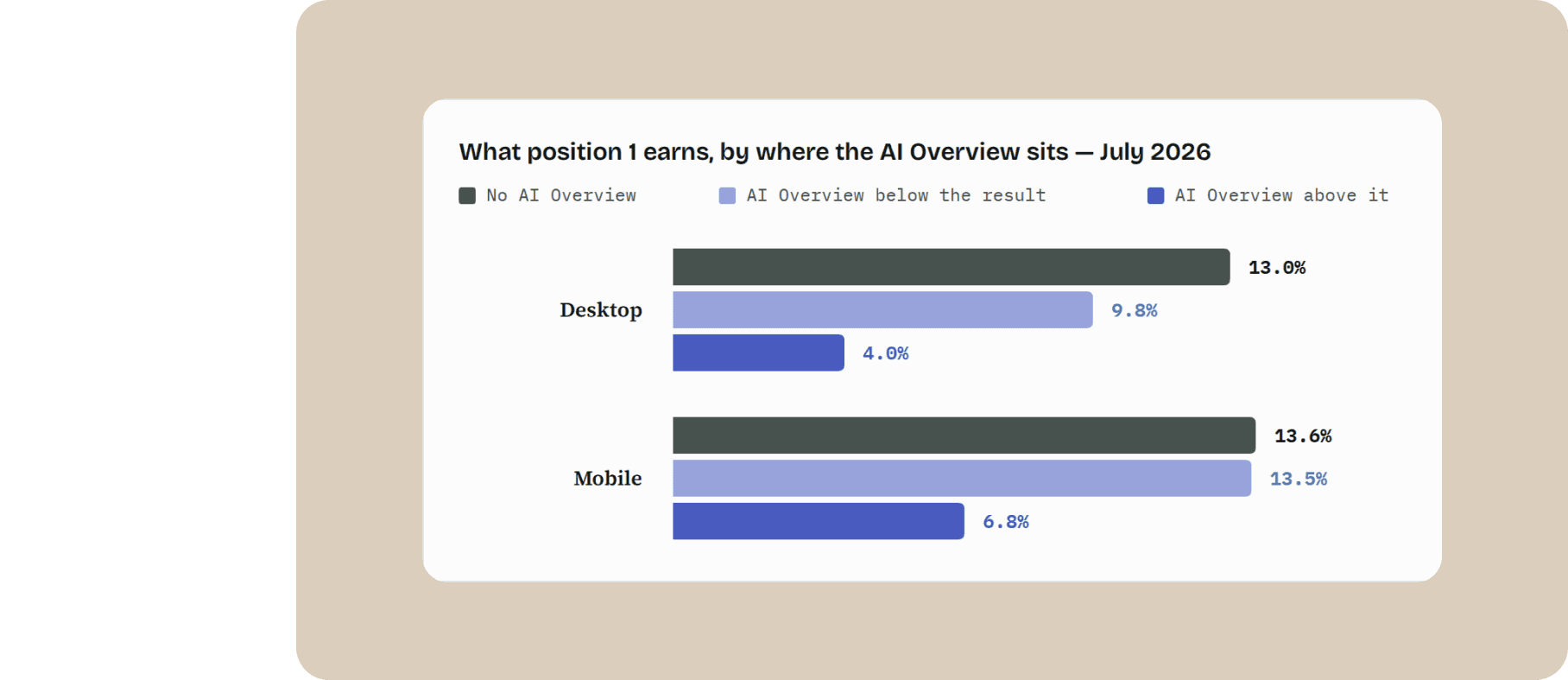
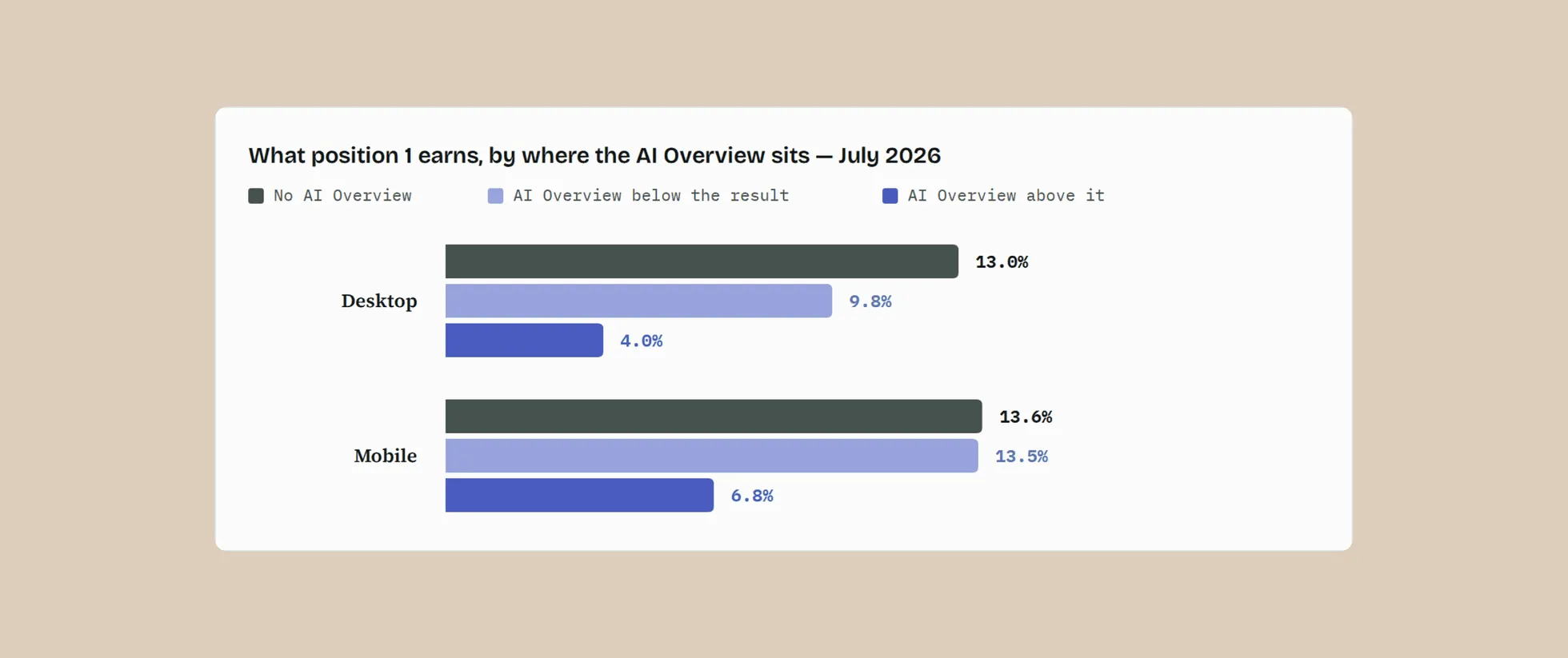
Our research into AI Overviews offers a good example.
In July 2026, the top organic result on desktop had an average CTR of 13% on SERPs without an AI Overview, compared with just 5.2% when an AI Overview was present. And AI Overviews are only one of many SERP features influencing how users interact with search results.
Dynamic CTR considers these differences when estimating the clicks your rankings could generate. It gives you a better and more realistic estimate of what your rankings could deliver.
3. When you need more credible SEO forecasts
SEO forecasting is already tricky enough. You are trying to estimate future results based on search volumes, expected rankings, and assumptions about how many people will actually click.
Plenty of moving parts. And plenty of opportunities for your assumptions to get a little too optimistic.
But imagine you are presenting a forecast to a client or management team. You have identified a set of promising keywords, mapped out potential ranking improvements, and calculated the traffic those improvements could generate.
What happens if your forecast assumes that every rank 3 has the same click potential, regardless of what the SERP looks like? Well, you might end up promising more traffic than you could realistically generate. And explaining to a client why the results differ six months later is probably not anyone’s favorite meeting.
When you are using forecasts to justify SEO investments, secure budgets, or set expectations with clients, you need more realistic CTR estimates that consider what is happening on the SERP.
No one can predict the future. Rankings change, search demand fluctuates, and Google has a habit of keeping us on our toes. But a credible forecast starts with credible assumptions. And more realistic CTR estimates are a pretty good place to start.
Worried About Your Numbers Changing?
If you have been using static CTR for a long time, you know the numbers it produces. You might have reporting processes, targets, or historical comparisons built around them.
And switching to dynamic CTR in AccuRanker can bring some of your numbers down, because CTR is used to calculate metrics like Share of Voice and Traffic Value.
But before you raise an eyebrow, there is one thing to remember: A lower estimate does not mean your performance has gotten worse. Your actual rankings and traffic remain exactly as they were. What changes is how the click potential associated with those rankings is estimated.
So, ask yourself this: Would you rather base your decisions on a familiar but misleading number or one that takes the actual SERP into account? That is really what the switch comes down to. The goal is not to make your estimate look better, but to make it more useful.
So yes, you might need to adjust some reports or explain the change in methodology to your stakeholders. But that is a small price to pay for estimates that give you a more realistic picture of your organic opportunity.
Maybe It Is Time to Flip the Switch
If you have been using static CTR for years, we understand why you might be reluctant to change. Familiar numbers are comfortable, and nobody enjoys adjusting a reporting setup that already works.
But with our rebuilt CTR model, it might be a good time to see what you have been missing. You already track your rankings in AccuRanker, so why not get a more detailed picture of the click opportunities behind them?
Your rankings will not budge, but your perspective on them might. Flip the switch and turn on dynamic CTR in AccuRanker.
Related blog posts
A New Dynamic CTR Model Built for Today’s SERPs
Learn why we rebuilt our Dynamic CTR model and how it delivers more accurate CTR estimates based on real click behavior and today’s SERPs.
7 October 2026
Meet the Next Generation of Our CTR Model
Meet our rebuilt dynamic CTR model, delivering more accurate CTR estimates based on deeper SERP insights and current click behavior.
22 October 2026
Why Your CTR Model Is Betraying You
A static CTR model relies on fixed averages. AccuRanker's dynamic CTR model accounts for 120+ factors to calculate a keyword's expected CTR.
2 June 2026