

How AccuRanker Determines Search Intent With AI

Peter Emil Tybirk
December 10, 2024
Learn how AccuRanker determines search intent with AI and what SERP features determine search intent.
Manually determining a keyword’s search intent is time-consuming and often prone to error. That is why we developed our AI Search Intent, which automatically decodes what Google really shows users, not just what keywords suggest. The model makes it easier to determine what type of content you should create to target a keyword.
In this article, we refer to a SERP/keyword pair as a keyword for brevity, even though a keyword can have varying SERPs. Now, let us explore how AI Search Intent helps you uncover what your audience is looking for.
Why Search Intent Is Complex
Search intent is not black and white. One keyword can mean different things depending on the context. So, creating a fixed set of rules to determine search intent does not work in a constantly changing SERP landscape. That is why we developed a machine learning model.
The model analyzes the SERP data that AccuRanker processes daily to find patterns and determine what kind of content Google favors for each keyword. It automatically identifies the search intent, making it easier to target keywords and create content matching the query's search intent.
Let us dig deeper into how we trained the model.
How We Trained the Model
We trained the model using unlabeled and hand-labeled data. Human experts labeled the keywords and their corresponding SERP data with their search intent. This way, we taught the model to recognize patterns and apply them to keywords outside the dataset.
Machine learning enables us to predict search intent more precisely, with over 90% agreement with human labels. However, reaching 100% precision is impossible for several reasons:
- Even humans (up to 40%) looking at SERPs disagree about the search intent.
- The SERP can display multiple intents.
- The definition of different search intent categories is not 100% aligned.
We will now go through how the model detects search intent.
How AccuRanker Detects Real User Intent
Our AI Search Intent model uses more than 100 factors to determine the intent of a search query. Some of these factors include:
- Keyword wording (translated to multiple languages)
- Titles and descriptions
- URLs
- SERP features like featured snippets and sitelinks
- Other SERP metadata, such as cost-per-click and Google Ads competition.
These factors do not work in isolation. The model understands how combinations of factors interact and influence search intent — something traditional rule-based approaches cannot do.
Visualizing which Features Determine Search Intent
One way to understand the new search intent model is to look at SHAP visualizations of how the features affect the model output in different cases. Here, you get a glimpse of how the AI Search Intent model makes decisions, shown slightly simplified:
- The y-axis shows the most impactful features for identifying whether a keyword belongs to the specific search intent category.
- The x-axis shows the individual features' impact on the model output, going from negative to positive. The vertical line separates negative and positive impacts.
- Each dot represents a keyword. The dot color maps the value of the corresponding feature for this keyword. Red means a high value, and blue means a low value.
In the following sections, we will explain how the model determines keywords’ search intent by looking at the features appearing on the SERP for the query.
Transactional Intent
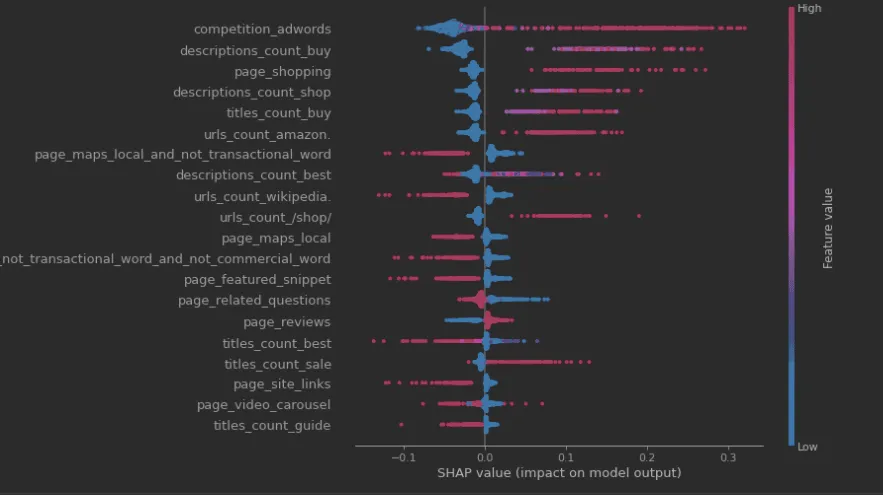
Transactional intent reflects that a user is ready to take action, typically to make a purchase. The chart below shows the top 20 features determining whether the search intent is transactional.
Our model identifies this intent by analyzing features like high competition in Google Ads, Amazon listings, and commercial domains. If these features are prominent, the model flags the keyword as transactional.
Let us take competition on Google Ads (competition_adwords) as an example. Next to competition_adwords on the chart, red dots appear to the right of the vertical line, which means high competition on Google Ads (a red dot). A high ad competition makes it more likely to be a transactional keyword (to the right of the vertical line).
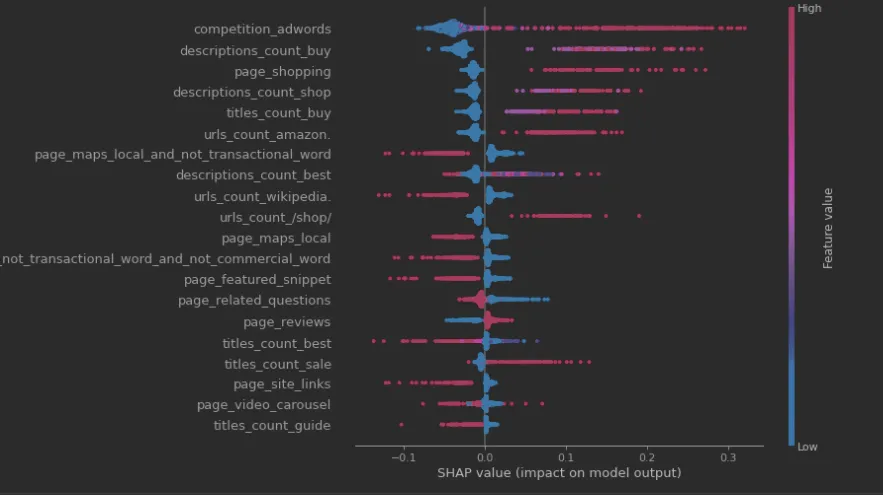
Another thing to highlight is that Amazon is present one or more times (urls_count_amazon), which makes it more likely that the SERP is transactional.
Interestingly, the presence of featured snippets or Wikipedia links indicates other intents. The value is high (red dot) if a featured snippet (page_featured_snippet) is on the SERP. The red dots are all to the left of the vertical line, indicating that it is less likely to be a transactional keyword.
Notice how the dots spread out on the x-axis instead of on top of each other. This is because the impact of SERP features on the model depends on which other features are present on the SERP. So, due to the high competition for Google Ads, the model does not necessarily conclude that the keyword is transactional.
Informational Intent
Informational intent often occurs when users want answers, explanations, or knowledge. This chart shows the top 20 features determining whether the intent is informational.
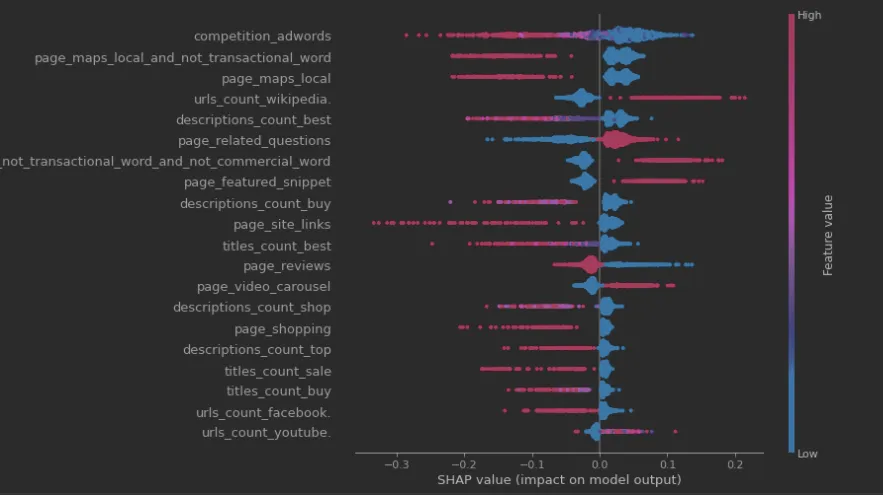
The chart reveals that high competition on Google Ads means it is unlikely to be informational intent. With the informational intent, users are looking to learn, not to buy. Furthermore, informational intent often ties to features like video carousels, related questions and featured snippets.
On the contrary, if the keyword includes “best”, it typically indicates commercial rather than informational intent. The same goes for SERP features like reviews and local results (page_maps_local). Another insight is that when Facebook appears in the SERP, the intent is typically not informational but navigational.
Navigational Intent
Navigational intent reflects when users try to reach a specific site or brand. Here, the goal is often direct navigation rather than information or purchase. The chart below shows the top 20 features determining whether the intent is navigational.
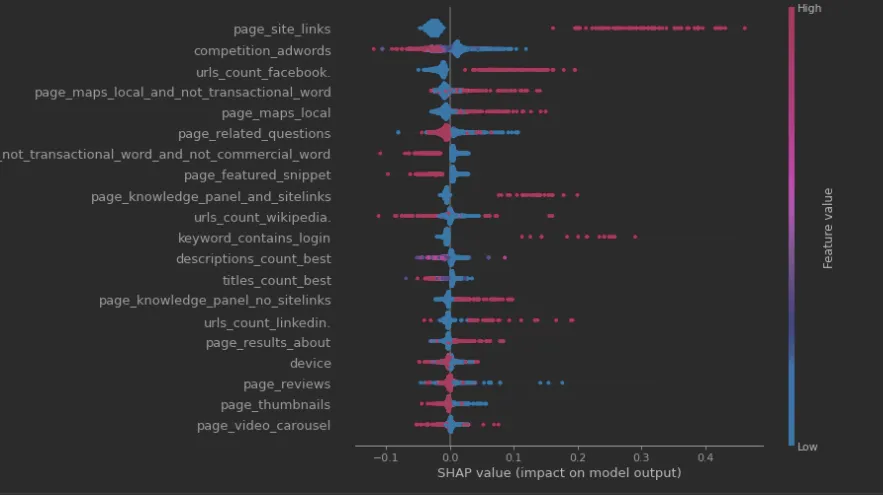
The chart shows that sitelinks are often associated with navigational intent. Knowledge panels are frequently present for keywords with navigational intent, but usually also for informational keywords.
Branded domains like LinkedIn, Twitter, and Facebook often appear on SERPs with navigational intent. These indicators suggest that users are looking for a specific website. Local results and results about are also associated with navigational intent. However, local results can also be associated with commercial intent, depending on the context.
There will typically not be high competition on Google Ads, featured snippets, or thumbnails for navigational intent.
Commercial Intent
Commercial intent lies between informational and transactional intent. It involves users researching products or services with the possibility of converting later. For commercial intent, you will mostly see items we have already described.
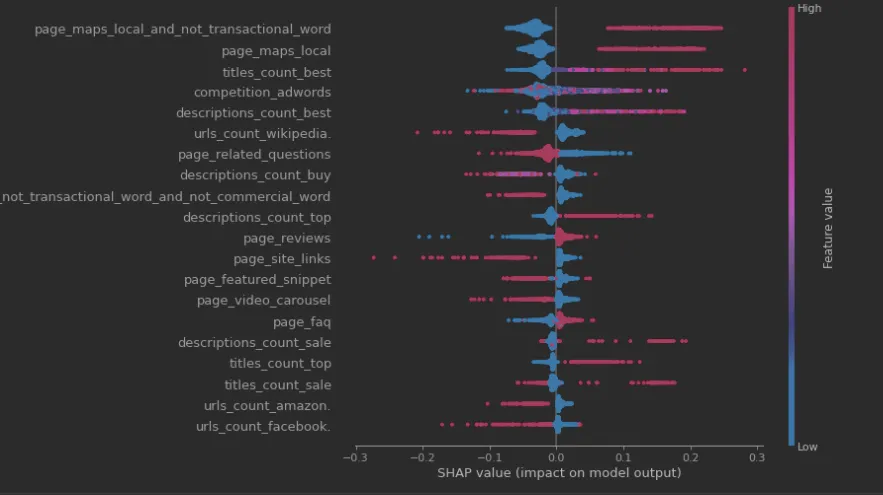
Our model flags this intent when it sees terms like “top” and “best”, along with SERP features like FAQs and reviews. Also, local results (maps_local) are often associated with commercial intent.
In contrast, you will typically not see words like “buy” or “sale” because they are usually tied to transactional rather than commercial intent. Similarly, domains like Amazon, Facebook, or Wikipedia are often not seen in keywords with commercial intent.
An Exception to the Rule
It is important to remember that SERPs are complex. A keyword might typically show navigational intent but still trigger features showing other intents. The charts and examples in this blog post give overall indications for each type of intent.
AccuRanker’s model is designed to reflect this complexity. Unlike rule-based models, which treat features independently, our model understands how they interact. Some combinations can make a particular intent more or less likely, depending on what else appears on the SERP. This is possible thanks to the data we train on and the machine-learning techniques we apply.
That is why the model’s intent predictions are so reliable — they account for the real-world messiness of SERPs and search behavior.
A Smart Way to Determine Search Intent
Let us put all the technical stuff aside and focus on why search intent is crucial in SEO. Google wants to show its users the best results, and matching a user’s search intent is essential to ranking high in the SERP. The better your content matches the user’s needs, the more traffic you attract, which leads to more revenue.
AccuRanker’s AI Search Intent helps you automatically identify a keyword’s search intent. This means you can find relevant keywords to target and craft content that reflects the user’s intent. Thus, you do not have to waste time analyzing the search query yourself or targeting keywords that do not meet the user’s requirements.
We have not taught the AI Search Intent model any rules. Instead, it discovers its own rules by pattern matching with numerous examples. Our AI Search Intent gives insights powered by real data, not guesswork.
Related blog posts
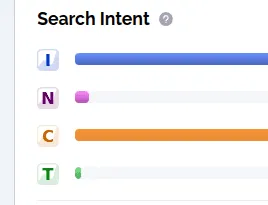
What is search intent?
A primer on AccuRanker’s search intent feature.
21 September 2022
How to Attract the Right Traffic with User Intent
Satisfying user intent is essential to creating content that ranks well in search engines and attracts lots of traffic.
23 November 2022
How AccuRanker’s AI Models Fix Inaccurate SEO Data
Struggling with unreliable SEO data? Discover how AccuRanker’s CTR, Search Intent, Search Volume, and Share of Voice deliver accurate insights.
1 June 2025